
Skin & Aesthetics · Vascular spots
Hemangioma Laser Treatment in Seoul for Adults: Red Vascular Spots
Hemangioma laser treatment uses a vascular laser to heat and close the small blood vessels that make up red or purple skin growths, such as cherry angiomas and spider angiomas, so they fade or disappear. At Hommage Clinic in Gangnam, Seoul, Dr. Hwang Seonhwa treats these acquired spots in adults; hemangiomas in babies and children are referred to pediatric specialists.
Quick answer
Hemangioma laser treatment for adults uses a vascular laser (532 nm KTP, 585–595 nm pulsed dye or 1064 nm long-pulsed Nd:YAG) to close the tiny vessels in cherry angiomas, spider angiomas and venous lakes. At Hommage Women's Clinic in Gangnam, Seoul, Dr. Hwang Seonhwa checks each spot first; sessions take 5–20 minutes, small spots often clear in 1–2 sessions, and marks fade in 1–2 weeks. Babies' hemangiomas are referred to pediatric specialists.
Key takeaways
- "Hemangioma" covers several different red spots. In adults, most are harmless cherry angiomas, spider angiomas or venous lakes.
- The laser wavelength is matched to the spot: shorter wavelengths for small, bright red spots near the surface, 1064 nm for deeper, bluish lesions.
- A treated cherry angioma rarely returns, but new ones can appear with age.
- Infant hemangiomas need a pediatrician, not a cosmetic clinic. Oral propranolol is the first-line medicine when treatment is needed.
- Any spot that grows fast, bleeds easily or looks unusual is diagnosed before it is treated.
Infographic
Hemangioma laser in numbers
Session time
Depends on how many spots are treated.
Sessions for small spots
Typical for small cherry angiomas; larger lesions need more.
Visible healing
Gray or purple marks and small crusts settle.
Between sessions
For larger, raised or deeper lesions.
Main laser types
KTP 532 nm, pulsed dye 585–595 nm, Nd:YAG 1064 nm.
Studies reviewed
A 2020 systematic review found no single best method for cherry angiomas.
Hemangioma laser at a glance
| Key fact | Details |
|---|---|
| Who it's for | Adults with small acquired vascular spots; infants and children are referred to pediatric care |
| Common lesions | Cherry angiomas, spider angiomas, venous lakes on the lips or ears |
| Treatment time | Usually 5–20 minutes, depending on the number of spots |
| Sessions | Often 1–2 for small cherry angiomas; more for larger or deeper lesions |
| Downtime | A small gray, purple or crusted mark for about 1–2 weeks |
| How long results last | Treated spots usually do not return, but new ones can appear with age |
| Reviewed by | Dr. Hwang Seonhwa, physician for skin and aesthetic treatments |
Laser may suit you if you are an adult with
- Bright red or purple dome-shaped spots on the body or face (cherry angiomas)
- A red dot with fine radiating vessels (spider angioma)
- A soft dark blue or purple bump on the lip or ear (venous lake)
- Leftover redness or fine vessels from a childhood hemangioma that has shrunk
Seek specialist care instead if
- The hemangioma is on a baby or child; see a pediatrician or pediatric dermatologist promptly
- A spot is growing quickly, bleeding easily or ulcerated and has not been diagnosed
- The lesion is large, deep, or a birthmark present since birth, which needs a vascular anomaly team
- You are pregnant; many pregnancy-related red spots shrink after delivery
What is a hemangioma?
A hemangioma is a benign growth made of extra blood vessels in the skin. The word is used for several different lesions, and the right care depends on which one you have and how old you are.
- Infantile hemangioma: the classic "strawberry mark" of babies. It appears in the first weeks of life, grows quickly for a few months, then slowly shrinks over several years.
- Cherry angioma: a small, bright red or purple dome-shaped spot that commonly appears from the 30s onward, especially on the trunk and arms. It is harmless and very common.
- Spider angioma: a red central dot with fine vessels radiating from it, often on the face, neck and upper chest. These are common in pregnancy and with hormonal changes.
- Venous lake: a soft, dark blue or purple bump, usually on the lip or ear of older adults with sun damage.
Port-wine stains and other birthmarks present from birth are vascular malformations, not hemangiomas. They behave differently and are usually managed by specialist hospital teams.
Who treats hemangiomas in babies and children?
Infantile hemangiomas should be assessed by a pediatrician or pediatric dermatologist, not a cosmetic clinic. Hommage Clinic does not treat infants or children with hemangiomas and will help you find appropriate pediatric care.
Most infantile hemangiomas need only monitoring, because they shrink on their own. Early specialist review, ideally within the first month or two of life, matters for those near the eyes, nose, lips or ears, large or segmental ones, those that ulcerate, and babies with several hemangiomas. When treatment is needed, oral propranolol, a beta-blocker medicine, is the internationally recommended first-line option. Topical timolol may be used for small, thin ones. Pulsed dye laser has a supporting role, mainly for ulcerated areas or for redness left after the hemangioma has shrunk.
If you are an adult with leftover redness or fine vessels from a childhood hemangioma, laser can help that redness. Loose skin or fatty tissue left behind may need surgical revision by a plastic surgeon.
How does laser treat adult vascular spots?
A vascular laser sends light that is absorbed by the blood inside the lesion. The light turns into heat, which closes the small vessels, and the body clears them over the following weeks.
- Pulsed dye (585–595 nm) and KTP (532 nm) lasers suit small, bright red cherry angiomas and spider angiomas close to the surface.
- Long-pulsed Nd:YAG (1064 nm) laser reaches deeper and suits thicker, darker or bluish lesions such as venous lakes.
Fine-needle electrocautery is an alternative for tiny cherry angiomas, and shave removal is used for raised lesions that bleed or need diagnosis. Spider angiomas are closely related to broken capillaries and are treated in a similar way.
What happens during treatment, and does it hurt?
Most sessions take 5 to 20 minutes, depending on how many spots are treated. Dr. Hwang first examines each spot, often with a dermatoscope, to confirm it is a benign vascular lesion. You wear eye shields, the skin is cooled, and each spot receives one or a few short pulses.
Each pulse feels like a quick, hot snap of a rubber band. Numbing cream is rarely needed for a few small spots but can be used for many lesions or sensitive areas such as the lip. Small cherry angiomas often turn gray or dark purple right away, which is the expected response.
Recovery and results: do cherry angiomas come back?
A treated cherry angioma usually does not grow back, but new ones tend to appear with age, so some people return for occasional touch-ups. Small spots often clear in one or two sessions; larger, raised or deeper lesions may need several sessions about four to six weeks apart.
After treatment, the spot may look gray, purple or slightly swollen, and a small crust can form. These changes usually settle within one to two weeks, leaving the spot faded or gone.
Aftercare
- Keep the area clean and apply a simple ointment if a crust forms.
- Do not pick crusts; let them fall off naturally.
- Avoid saunas and very hot baths for a few days.
- Protect treated areas from the sun to reduce the chance of dark marks.
Risks and possible side effects
Laser treatment of small vascular spots is generally well tolerated, but side effects can occur. Expected, temporary effects are redness, swelling, bruising and small crusts.
Less common side effects include:
- Incomplete clearance , needing another session.
- Temporary dark or light marks , more likely in tanned or darker skin.
- Blistering and, rarely, a small scar or dent , especially with larger lesions or electrocautery.
- Bleeding if a crust is knocked off early.
Correct diagnosis is the most important safety step. A red bump that grows quickly and bleeds easily may be a pyogenic granuloma, which is usually removed and sent for laboratory examination, and rarely other skin growths can look similar. Contact the clinic if a treated area becomes painful, hot, oozing or keeps bleeding, or if any spot grows back quickly.
Hemangioma laser treatment at Hommage Clinic
Hommage Clinic is a women's health and skin clinic in Gangnam, a short walk from Sinnonhyeon Station, and welcomes walk-ins during opening hours. Dr. Hwang Seonhwa treats adults with small acquired vascular spots such as cherry angiomas, spider angiomas and venous lakes. Infants and children, large vascular birthmarks and any lesion that needs a biopsy are referred to the appropriate specialist or hospital. If you also have brown or raised moles you want checked, seelaser mole removalfor how pigmented spots are assessed first.
Spider angiomas and red bumps often appear during pregnancy and may shrink afterward; the clinic's gynecology team can help with hormone-related skin changes, and you can read more inskin care for hormonal changes. Cosmetic removal of vascular spots is not covered by Korea's National Health Insurance. Cost depends on the number, size and type of lesions and the sessions needed, and you receive a written quote before treatment. Browse otherskin and aesthetic treatments.
Know your spot
Cherry angioma vs spider angioma vs venous lake: which red spot do you have?
Most red or purple spots that adults ask about are not true hemangiomas of infancy but one of three common, benign vascular lesions. They look different, sit at different depths in the skin and respond best to different laser settings, which is why naming the spot correctly is the first step of treatment. The diagram below shows the typical look of each one; the cards underneath explain where they appear and how they are usually treated.
Mechanism
How does laser remove a hemangioma or cherry angioma? Wavelength and depth
Vascular lasers work by selective photothermolysis: the light is tuned to a colour that hemoglobin in blood absorbs strongly, while the surrounding skin absorbs much less. The absorbed light becomes heat inside the vessel, the vessel wall is sealed, and the body clears the closed vessel over the following weeks. Longer wavelengths travel deeper into the skin, so the choice of laser depends on how deep and how dark the spot is, as well as on your skin tone.
 Hommage · Gangnam
Hommage Women's Clinic · Gangnam, Seoul
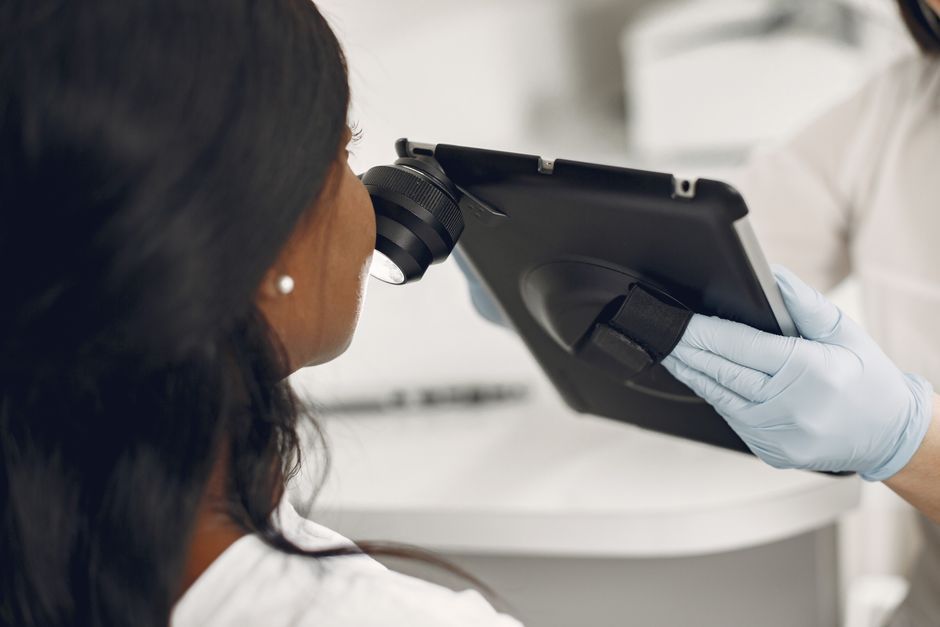
A dermatoscope magnifies the spot so the doctor can confirm it is a benign vascular lesion. Illustrative photo.
Safety first
When should a red spot be checked before laser?
Laser closes blood vessels; it does not produce a tissue sample. That is why Dr. Hwang Seonhwa looks at every spot before treating it, and why some spots are referred for diagnosis instead. Most red dots on adult skin are harmless, but a few look similar and need a different plan. The checklist below lists the signs that mean a spot should be examined, and sometimes removed and sent to a laboratory, rather than treated with laser straight away.
- It appeared recently and is growing fast Rapid growth over weeks is not typical of a cherry angioma.
- It bleeds with light contact or has a raw surface A pyogenic granuloma, for example, is usually removed and examined.
- It looks different from your other spots An "odd one out", uneven colour or irregular border should be checked.
- It has been there since birth or covers a large area Birthmarks and vascular malformations are managed by hospital teams.
- It is on a baby or child Infantile hemangiomas need a pediatrician or pediatric dermatologist.
- New spots appear in large numbers with other symptoms Many spider angiomas outside pregnancy can be worth a general medical check.
If you also have brown or raised spots you are unsure about, they are assessed separately; see laser mole removal for how pigmented spots are checked first.
Options compared
Laser vs electrocautery vs other methods for cherry angiomas
There is no single standard treatment for cherry angiomas. A 2020 systematic review of ten studies found that lasers, electrosurgery, cryotherapy and other methods can all work, and that few studies compare them head to head. The choice is therefore practical: how many spots you have, where they are, how raised they are, your skin tone and how much downtime you accept. The cards summarise the trade-offs.
Vascular laser
Closes vessels with light, with little surface wound. Good for many small spots and the face. May need more than one session for larger spots.Electrocautery
A fine needle delivers heat directly. Quick for very small spots, but slightly more likely to leave a small mark than laser.Shave removal
Removes the lesion so it can be examined in a laboratory. Used when the diagnosis needs confirming.Cryotherapy
Freezing has been reported to work, but it is less precise on small facial spots and can leave light marks.Which laser for which spot?
In a small comparison study, the 1064 nm Nd:YAG laser cleared cherry angiomas in fewer sessions than the 532 nm KTP laser, but caused more redness, swelling, pain and scarring, while KTP caused more temporary dark marks. In practice, bright red, flat-topped spots usually start with a shorter wavelength, and darker, thicker or bluish lesions move toward 1064 nm. Fine red lines around the nose and cheeks are a different problem, covered under broken capillary removal and rosacea laser treatment .
 Hommage · Gangnam
Hommage Women's Clinic · Gangnam, Seoul
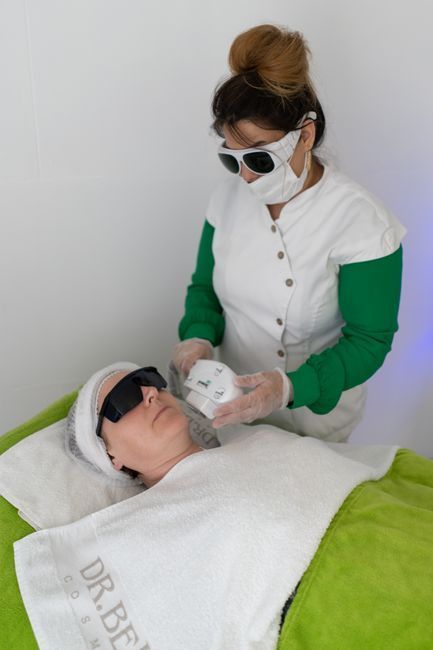
Eye shields and skin cooling are standard for every vascular laser session. Illustrative photo.
Healing
Cherry angioma laser recovery: what to expect day by day
Healing after laser for small vascular spots is short and predictable. The spot usually darkens straight away, may form a small crust over the next few days, and fades over one to two weeks. Larger, raised or deeper lesions are reviewed after about four to six weeks to decide whether another session is needed. The timeline below shows the usual pattern; your own course depends on the size and type of each spot.
 Hommage · Gangnam
Hommage Women's Clinic · Gangnam, Seoul
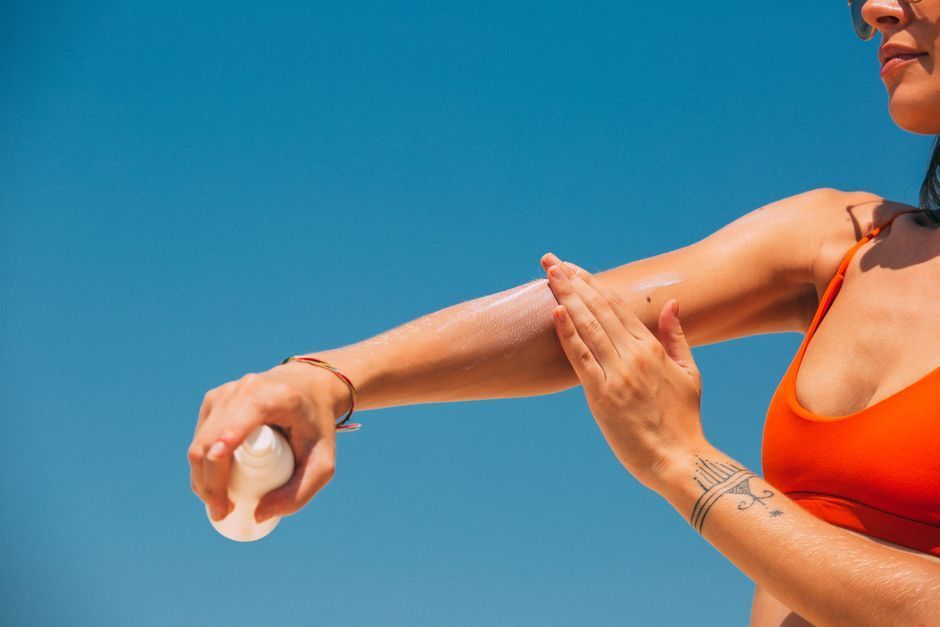
Daily sun protection on treated areas lowers the chance of temporary dark marks. Illustrative photo.
Aftercare
After hemangioma laser: do's and don'ts
Good aftercare keeps the small crust intact so the skin underneath heals smoothly, and it lowers the chance of a dark mark. You receive written instructions before you leave, and you can message the clinic with a photo if anything looks unexpected.
Do
- Wash gently with water and a mild cleanser, then pat dry
- Apply a thin layer of the ointment you are given if a crust forms
- Use a cool, clean compress for swelling on the lip or face
- Use broad-spectrum sunscreen on treated areas once the skin is closed
- Message the clinic if a spot oozes, becomes hot or keeps bleeding
Don't
- Pick, scratch or scrub off crusts
- Use saunas, hot baths or very hot showers for a few days
- Do intense exercise on the day of treatment if many spots were treated
- Apply exfoliating acids or retinoids on treated spots until healed
- Tan or use tanning beds before or after treatment
Women's skin
Red spots in pregnancy, after childbirth and with hormonal change
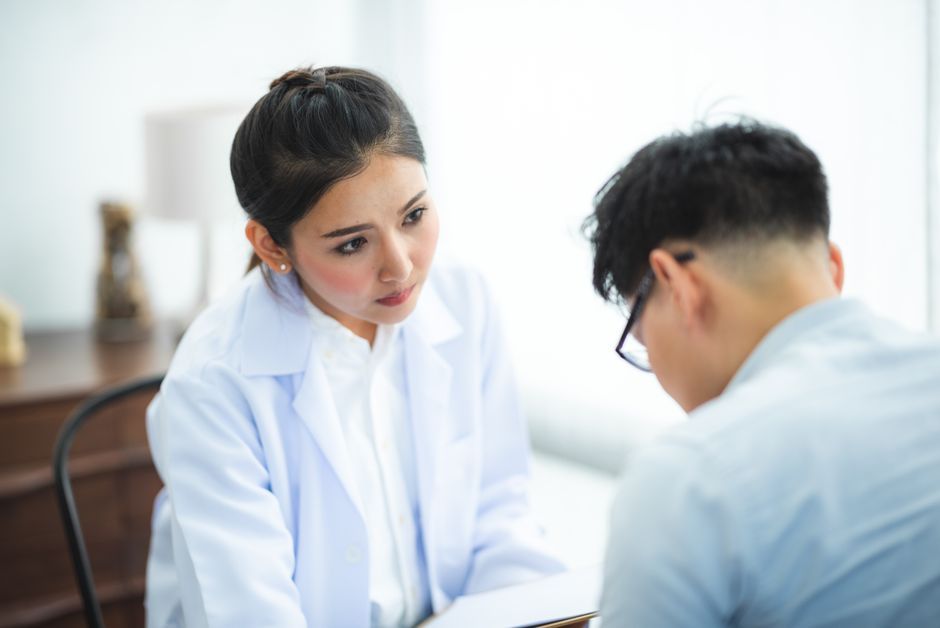
Spider angiomas and small red bumps are common in pregnancy, when blood volume and estrogen levels rise. Many of them fade within months of delivery, so laser is usually postponed until after pregnancy and, for most women, until after breastfeeding, when it is clearer which spots remain. A red bump that grows quickly on the gums or skin during pregnancy can be a pyogenic granuloma, which should be checked rather than treated as a simple angioma.
Spider angiomas can also appear with hormonal contraception and, more rarely, with liver conditions. If you notice many new spider angiomas outside pregnancy, especially together with tiredness or other symptoms, a general medical check is sensible before cosmetic treatment. Hommage Clinic's gynecology team can help with hormone-related skin changes; see skin care for hormonal changes .
Planning laser around life events
- Wait until after pregnancy for elective vascular laser.
- Plan treatment of visible facial spots at least two weeks before a wedding, photo shoot or trip.
- Treat in autumn or winter if you tan easily, to reduce the risk of dark marks.
 Hommage · Gangnam
Hommage Women's Clinic · Gangnam, Seoul
Many pregnancy-related red spots fade on their own, so timing is discussed first. Illustrative photo.
Evidence
Does laser work for cherry angiomas and venous lakes? What the research says
Laser treatment of small vascular spots is widely used and generally effective, but the research behind it is modest. Most studies are small, compare only two methods, and follow patients for a short time. The reviews and guideline below are the most useful summaries; they support laser as a reasonable option for adults while noting that no single method has been proven best.
Studies on cherry angiomas
Laser and non-laser methods all worked; pulsed dye laser caused less pain than KTP or electrodesiccation. No method was clearly superior.
Buslach et al., Dermatol Surg, 2020KTP vs Nd:YAG
Nd:YAG needed fewer sessions but caused more redness, pain and scarring; KTP caused more temporary dark marks.
Pancar et al., J Cosmet Laser Ther, 2011Venous lakes
A literature review found laser and light treatments safe and effective, with long-pulsed Nd:YAG showing particular benefit.
Mlacker et al., Lasers Med Sci, 2016Infant growth phase
Infantile hemangiomas grow fastest between 1 and 3 months of age, which is why early pediatric review matters.
AAP Clinical Practice Guideline, 2019Traveling to Seoul
Cherry angioma and red spot removal in Seoul for international patients
Laser for small vascular spots fits easily into a short stay in Seoul. Hommage Women's Clinic is in Gangnam, a short walk from Sinnonhyeon Station (Line 9 and Shinbundang Line), and welcomes walk-ins during opening hours, although booking ahead is best if you want a specific day.
Before you come
- Send photos of your spots and your travel dates by WhatsApp, KakaoTalk or the contact form, and ask for language support if needed.
- Avoid tanning in the weeks before your visit.
- Bring your passport for registration and a list of your medicines, especially blood thinners.
- Plan treatment early in your trip, so a small crust can start healing before you fly.
After you fly home
Small crusts usually heal within one to two weeks. Keep them clean, protect them from the sun and send a photo to the clinic if you have questions. Larger lesions that need a second session can be treated on a later visit or by a dermatologist at home.
 Hommage · Seoul
Hommage Women's Clinic · Gangnam, Seoul
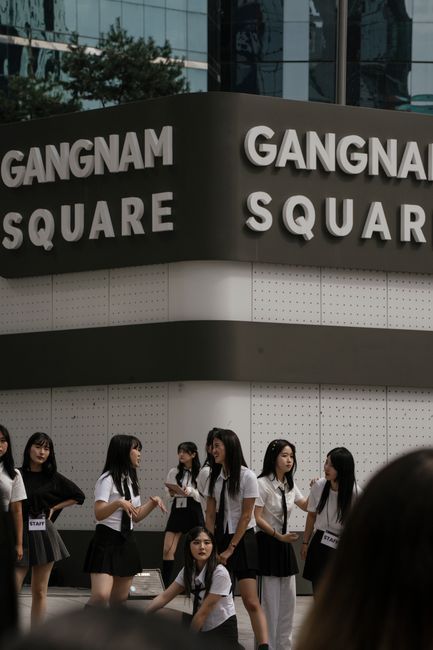
Gangnam, Seoul: the clinic is a short walk from Sinnonhyeon Station. Illustrative photo.
 Hommage · Gangnam
Hommage Women's Clinic · Gangnam, Seoul
You receive a written plan and quote before treatment. Illustrative photo.
Choosing well
How to choose a clinic for hemangioma laser in Seoul
Many Gangnam clinics offer red spot removal. These questions help at any consultation, including ours:
- Does a doctor examine every spot first? Diagnosis should come before any laser pulse.
- Which wavelengths are available? Access to more than one vascular laser lets the treatment match the spot.
- Will they refer if something looks unusual? A good clinic says when a spot needs a biopsy or a hospital team.
- Do they decline to treat infants? Babies' hemangiomas belong with pediatric specialists.
- Do they explain skin-tone risks? Dark marks are more likely in tanned or darker skin.
- Is the plan and quote written down? Including how many sessions may be needed.
What affects the cost of hemangioma laser in Seoul?
The cost depends on the number of spots, their size and depth, the laser used, whether numbing cream is needed and how many sessions are expected. Raised lesions that need removal and laboratory examination are priced differently from laser alone. Cosmetic removal of vascular spots is not covered by Korea's National Health Insurance, and you receive a written quote before treatment. If you also want help with general redness, see redness reduction therapy or IPL .
Your visit
What to expect at your appointment
01
Examination
Dr. Hwang examines each spot, often with a dermatoscope, and asks how long it has been there and whether it has changed or bled.
02
Plan
Benign vascular spots are matched to a laser wavelength or another method. Anything unusual is referred for diagnosis first.
03
Treatment
With eye protection and skin cooling, each spot receives short pulses. Most sessions take 5–20 minutes.
04
Healing
Spots fade over 1–2 weeks. A follow-up is booked if a larger lesion needs another session.

Your doctor
Dr. Hwang Seonhwa
Physician · Skin & Aesthetic Treatments
Dr. Hwang confirms that each red or purple spot is a benign vascular lesion before treating it, matches the laser to its size and depth, and refers children and any uncertain lesion to the right specialist.
Physician for face and skin procedures, including lifting, laser and skin-improvement treatments, planned around facial proportions and skin condition.
Hemangioma laser: frequently asked questions
Should my baby's hemangioma be treated with laser?
Usually not as a first step. Most infantile hemangiomas shrink on their own, and those that need treatment are generally treated with oral propranolol prescribed by a pediatric specialist. Laser is mainly used for ulcerated areas or leftover redness. Please see a pediatrician or pediatric dermatologist early, especially if the hemangioma is on the face or growing fast. Hommage Clinic does not treat children.
What is a cherry angioma, and is it dangerous?
A cherry angioma is a small, bright red or purple spot made of tiny blood vessels. It is benign and very common, appearing more often with age, usually on the trunk and arms. It is not dangerous, but a doctor should check any red spot that grows quickly, bleeds easily or looks different from your others.
Do cherry angiomas come back after laser removal?
A treated cherry angioma usually does not return. However, new cherry angiomas can keep appearing over the years, because the tendency to form them increases with age and is partly inherited. Many people treat new spots every year or two as needed.
Does hemangioma laser treatment leave a scar?
Scarring is uncommon with laser treatment of small vascular spots. Most treated spots turn gray or purple, form a small crust and heal within one to two weeks. The risk of a small scar or dent is higher with larger raised lesions, electrocautery, or if crusts are picked off. Temporary dark marks can occur, especially in tanned skin.
Laser or electrocautery for cherry angiomas: which is right for me?
Both can remove small cherry angiomas. Laser closes the vessels with light and tends to leave less surface wound, while fine-needle electrocautery is quick for tiny spots but carries a slightly higher risk of a small mark. Raised or bleeding lesions may be shaved off and examined instead. Dr. Hwang suggests a method after seeing your spots.
Can foreigners get hemangioma laser treatment in Seoul?
Yes, adults visiting or living in Seoul can book treatment for cherry angiomas and similar spots at Hommage Clinic; bring your passport for registration. Allow about one to two weeks for small crusts to heal. Contact us before your visit to arrange language support; you can walk in during opening hours or book ahead for a set time.
Which laser is used for cherry angiomas?
Small, bright red cherry angiomas are usually treated with a 532 nm KTP or 585–595 nm pulsed dye laser, which target blood close to the surface. Thicker, darker or bluish lesions may be treated with a 1064 nm long-pulsed Nd:YAG laser, which reaches deeper. Dr. Hwang Seonhwa chooses the wavelength after examining each spot and your skin tone.
How many sessions does hemangioma laser treatment need?
Small cherry angiomas often clear in one or two sessions. Larger, raised or deeper lesions, such as some venous lakes, may need several sessions about four to six weeks apart. You are told the likely number at your consultation, but the response of each spot is checked before another session is planned.
Does laser for red spots hurt?
Each pulse feels like a quick, hot snap of a rubber band and lasts a fraction of a second. Skin cooling is used during treatment. Numbing cream is rarely needed for a few small spots, but it can be applied for many spots or sensitive areas such as the lip.
Can a venous lake on the lip be treated with laser?
Yes. A venous lake is a soft, dark blue or purple bump, usually on the lip or ear. A literature review found laser and light treatments safe and effective for venous lakes, with the long-pulsed 1064 nm Nd:YAG laser showing particular benefit. The lip may swell for a few days afterward, and a larger lesion can need more than one session.
Can I have cherry angioma laser while pregnant?
Elective laser for red spots is usually postponed until after pregnancy. Spider angiomas and small red bumps are common in pregnancy and many fade within months of delivery, so it is easier to see which ones remain afterward. A red bump that grows quickly during pregnancy should still be checked by a doctor.
Can laser remove spider angiomas on the face?
Yes. A short-wavelength vascular laser aims at the central feeding vessel, and the fine radiating vessels usually fade with it. One session is often enough for a small spider angioma, although some need a touch-up. Fine red lines without a central dot are treated as broken capillaries.
When should a red spot not be treated with laser straight away?
When it grows quickly, bleeds with light contact, looks different from your other spots, has been present since birth, covers a large area, or is on a baby or child. These spots need a diagnosis first, and some are removed and sent to a laboratory or referred to a hospital team.
References
Sources used for this page, reviewed by Dr. Hwang Seonhwa. Read our editorial and medical review policy.
- Buslach N, Foulad DP, Saedi N, Atanaskova Mesinkovska N. Treatment modalities for cherry angiomas: a systematic review. Dermatol Surg. 2020;46(12):1691–1697.
- Pancar GS, Aydın F, Şentürk N, et al. Comparison of the 532-nm KTP and 1064-nm Nd:YAG lasers for the treatment of cherry angiomas. J Cosmet Laser Ther. 2011;13(4):138–141.
- Mlacker S, Shah VV, Aldahan AS, et al. Laser and light-based treatments of venous lakes: a literature review. Lasers Med Sci. 2016;31:1511–1519. PubMed
- American Academy of Pediatrics. Clinical practice guideline for the management of infantile hemangiomas. Pediatrics. 2019;143(1):e20183475.
- Hoover L. Infantile hemangioma: AAP releases guideline for management. Am Fam Physician. 2019;100(3):186–187. AAFP
This page is general information and does not replace a personal consultation. Illustrations are original works of Hommage Women's Clinic, Gangnam, Seoul; photos marked illustrative are not of patients.
Related vascular and spot treatments
Vascular Laser
How 595, 532 and 1064 nm lasers close blood vessels in the skin.
Broken Capillary Removal
Laser removal of fine red lines and spider veins on the face.
Laser Mole Removal
Why moles are checked before any treatment, and when laser is suitable.
Age Spot Removal
Treatment for flat brown spots that often appear alongside cherry angiomas.
Redness Reduction Therapy
A cause-first plan for persistent facial redness.
Skin Care for Hormonal Changes
Why spider angiomas and red bumps can appear in pregnancy.
Have your red spots checked and treated
Book an appointment with Dr. Hwang Seonhwa in Gangnam. Each spot is examined first, then treated with a laser matched to its size and depth.
Hommage Clinic · 4F, Building A, 509 Gangnam-daero, Seoul (near Sinnonhyeon Station) · Mon & Fri 10:00–20:00 · Tue–Thu 10:00–19:00 · Sat 10:00–15:00