
Gynecology · Fertility & cycle health
AMH Test in Gangnam, Seoul: What Your Ovarian Reserve Result Means
An AMH (anti-Müllerian hormone) test is a blood test that estimates how many eggs remain in your ovaries, known as your ovarian reserve. It does not measure egg quality or predict on its own whether you can get pregnant naturally. At Hommage Clinic in Gangnam, Seoul, OB/GYN specialist Dr. Park Yuna interprets your AMH with your age, cycle history and an ultrasound follicle count.

Quick answer
An AMH test is a single blood test, taken on any day of your cycle with no fasting, that estimates how many eggs remain in your ovaries (your ovarian reserve). At Hommage Women's Clinic in Gangnam, Seoul, female OB/GYN specialist Dr. Park Yuna reads your AMH together with your age, cycle history and an ultrasound antral follicle count. AMH helps plan egg freezing, IVF and PCOS assessment, but it does not measure egg quality or predict natural pregnancy on its own.
Key takeaways
- AMH reflects egg quantity, not egg quality. Age remains the best guide to quality.
- In a study of 750 women trying to conceive naturally, a low AMH did not lower the chance of pregnancy within 12 cycles.
- AMH is good at predicting how many eggs may be collected in egg freezing or IVF, which is where it is most useful.
- Hormonal contraception can lower AMH somewhat, so tell the doctor what you use; do not stop it just for the test.
Infographic
The AMH test in numbers
Cycle timing
AMH stays fairly stable through the cycle; no fasting needed.
Blood draw
A single sample from the arm, often paired with an ultrasound follicle count.
ng/mL to pmol/L
1 ng/mL is about 7.1 pmol/L. Check the unit before comparing reports.
Low AMH, natural conception
Conceived within 12 cycles, vs 75% with normal AMH (Steiner et al., JAMA 2017).
Lower on the pill
Average AMH difference in oral contraceptive users (887 women, Hum Reprod 2015).
Results
Usually within a few working days, explained in person or by message.
The AMH test at a glance
| Key fact | Details |
|---|---|
| What it measures | A hormone from small ovarian follicles that reflects the remaining egg supply |
| What it does not show | Egg quality, or your chance of natural pregnancy on its own |
| Timing | Any day of the cycle; no fasting needed |
| How it's done | A single blood draw from the arm, often with an ultrasound follicle count |
| Common uses | Egg-freezing and IVF planning, PCOS assessment, early menopause concerns |
| Results | Usually within a few working days, compared with age-specific ranges |
| Reviewed by | Dr. Park Yuna, OB/GYN specialist |
An AMH test can be useful if you
- Are considering egg freezing or want to plan the timing of pregnancy
- Are preparing for IVF and need to estimate how your ovaries may respond
- Have irregular periods and possible PCOS
- Have had ovarian surgery or chemotherapy, or early menopause runs in your family
- Have missed periods or hot flashes before age 40
An AMH test alone is not enough if you
- Want to know whether you can get pregnant naturally right now
- Have been trying to conceive for 12 months (6 if 35 or older): you need a full fertility work-up
- Want a home test to decide whether you need contraception: AMH cannot tell you that
What is AMH?
Anti-Müllerian hormone (AMH) is made by the cells surrounding small, developing follicles in your ovaries. Because each follicle holds an immature egg, the AMH level in your blood gives an estimate of how many eggs remain, which doctors call ovarian reserve.
You are born with all the eggs you will ever have, and the number falls steadily with age. AMH usually declines through your 30s and becomes very low around menopause. Unlike FSH and estradiol, AMH stays fairly stable across the menstrual cycle, so the test can be done on any day. It is often ordered alongside other hormone tests and an ultrasound count of small follicles, called the antral follicle count.
Does a low AMH mean you cannot get pregnant?
No. AMH reflects the quantity of eggs, not their quality, and you only need one healthy egg each cycle to conceive. Research in women trying to conceive naturally has found that a low AMH did not meaningfully reduce the chance of pregnancy over the following months.
Your age is a stronger guide to egg quality than AMH. A 32-year-old with a low AMH generally has better-quality eggs than a 42-year-old with a normal AMH. Equally, a normal or high AMH does not mean you will conceive easily, because tubes, sperm, the uterus and ovulation all matter too. If you are trying to conceive, AMH is one piece of the picture alongside ovulation testing , an ultrasound and, where appropriate, tests for your partner.
When is an AMH test useful?
AMH is most useful when the number of eggs affects a decision you need to make:
- Egg freezing and IVF planning: AMH helps predict how many eggs are likely to be collected after ovarian stimulation and guides medication doses. A lower result may suggest planning sooner rather than later.
- PCOS: AMH is often high in polycystic ovary syndrome because there are many small follicles. In adults, a raised AMH can support the diagnosis alongside other features. See PCOS treatment .
- Possible early menopause: a very low AMH, together with high FSH and missed periods before 40, can point to premature ovarian insufficiency. See low estrogen treatment .
- Before or after ovarian surgery or cancer treatment: AMH can help estimate the effect on ovarian reserve and plan fertility preservation.
AMH is not recommended as a general fertility check in women who are not planning anything, because a single number can cause unnecessary worry or false reassurance.
How is the AMH test done, and how are results read?
The test is a single blood draw and needs no fasting or cycle timing. Results usually come back within a few working days and are reported in ng/mL or pmol/L (1 ng/mL is about 7.1 pmol/L), so check which unit your report uses before comparing results.
There is no single "normal" AMH. Results are compared with ranges for your age, and laboratories use different assays, so values from two labs are not always directly comparable. Hormonal contraception, recent pregnancy and very low body weight can lower AMH somewhat, while PCOS often raises it. Dr. Park reads AMH together with your age, cycle pattern and a pelvic ultrasound antral follicle count before drawing conclusions.
Risks and limitations of the AMH test
The blood test itself is low risk: you may have brief needle discomfort, a small bruise or feel lightheaded. Call the clinic if the site becomes increasingly red, swollen or painful.
The bigger risks are misinterpretation. AMH cannot predict the exact age at which you will reach menopause, cannot tell you how long you can safely delay pregnancy, and cannot show egg quality. A low result may cause distress even when natural fertility is still good, and a normal result can give false reassurance if other problems exist. That is why we discuss what the number can and cannot tell you before the test, and explain the result in person.
AMH testing at Hommage Clinic
Hommage Clinic is a women's clinic in Gangnam, a short walk from Sinnonhyeon Station. AMH testing is planned and reviewed by Dr. Park Yuna, a female OB/GYN specialist, and an ultrasound follicle count can be done at the same visit. If your results suggest you should consider egg freezing or IVF, Dr. Park explains the options and arranges referral to a fertility center. Find our othergynecology serviceshere.
Walk-ins are welcome during opening hours. In Korea, an AMH test done for planning or screening is often not covered by National Health Insurance, while tests for a medical reason may be. Visitors without coverage pay the clinic's fees directly, and you receive a written quote before the test.
How it works
How does the AMH test work?
Each month a group of small follicles in your ovaries starts to develop. The cells lining these follicles, called granulosa cells, release anti-Müllerian hormone into the bloodstream. The more small follicles you have, the more AMH circulates, so a blood sample gives an indirect count of the follicles, and therefore the eggs, that remain. AMH does not depend on the pituitary hormones that drive the monthly cycle, which is why it stays relatively stable within and between cycles and can be tested on any day.
The number on its own is only the starting point. Dr. Park compares it with ranges for your age from the same type of laboratory assay, and where helpful adds a transvaginal ultrasound to count the antral follicles, which are small follicles of about 2–10 mm. The American Society for Reproductive Medicine considers AMH and the antral follicle count to be broadly equivalent measures of ovarian reserve.
Expectations
What an AMH test can and cannot tell you
Much of the anxiety around AMH comes from asking the test a question it was never designed to answer. AMH is a good guide to the number of eggs likely to respond to fertility medication. It is a poor guide to whether you will conceive naturally this year, and it says nothing about whether a given egg is chromosomally healthy. Professional bodies, including the American Society for Reproductive Medicine, describe ovarian reserve markers as good predictors of egg yield but poor predictors of reproductive potential once age is taken into account.
AMH can help estimate
- Roughly how many eggs remain compared with women your age
- How many eggs may be collected in an egg-freezing or IVF cycle
- Whether stimulation doses may need adjusting to avoid a low or excessive response
- Support for a PCOS diagnosis in adults, alongside other features
- A possible clue to early ovarian insufficiency, with FSH and cycle history
AMH cannot tell you
- Whether your eggs are good quality
- Your chance of natural pregnancy in the next year
- The exact age you will reach menopause
- How long you can safely wait to try for a baby
- Whether you still need contraception
 Hommage · Gangnam
Hommage Women's Clinic · Gangnam, Seoul
We explain what AMH can and cannot show before you take the test. Illustrative photo.
Comparing tests
AMH vs antral follicle count vs FSH: which ovarian reserve test?
Three tests are commonly used to estimate ovarian reserve. AMH is a blood test on any day. The antral follicle count (AFC) is a transvaginal ultrasound, ideally early in the cycle, that counts follicles of about 2–10 mm in both ovaries. Basal FSH is a blood test on cycle day 2–4 and is usually read with estradiol. ASRM notes that FSH varies considerably from cycle to cycle, which limits the reliability of a single result, whereas AMH and AFC are more consistent. UK NICE fertility guidance suggests using one of these measures to predict how the ovaries are likely to respond to IVF stimulation.
At Hommage Women's Clinic, AMH and an AFC from apelvic ultrasoundcan be done at one visit, and cycle-timedhormone testingis added when FSH, estradiol, thyroid or prolactin results would change the plan.
| Compare | AMH | Antral follicle count | Basal FSH |
|---|---|---|---|
| How | Blood draw | Transvaginal ultrasound | Blood draw, often with estradiol |
| When | Any day | Early follicular phase | Cycle day 2–4 |
| Consistency | Relatively stable within and between cycles | Low cycle-to-cycle variation in experienced hands | Varies considerably between cycles |
| NICE low-response marker | ≤5.4 pmol/L | ≤4 follicles | >8.9 IU/L |
| NICE high-response marker | ≥25 pmol/L | >16 follicles | <4 IU/L |
 Hommage · Gangnam
Hommage Women's Clinic · Gangnam, Seoul
AMH is most useful when it informs a real decision about timing. Illustrative photo.
Age and AMH
AMH levels by age: why your age matters more than the number
AMH is highest in the early to mid-20s and falls gradually through the 30s, more steeply in the late 30s and 40s, and becomes very low as menopause approaches. Because the decline is expected, a result is only meaningful when compared with women of the same age tested with the same assay. That is why we do not publish a single cut-off on this page: reference ranges differ between laboratories, and a value that is low at 28 may be typical at 40.
Egg quality follows age, not AMH. The proportion of eggs with chromosomal errors rises with age whatever your AMH, so two women with identical AMH results but a ten-year age gap face different chances of pregnancy. In practice this means a younger woman with low AMH may conceive easily but would collect fewer eggs if she froze them, while an older woman with normal AMH may collect many eggs of lower average quality.
After your result
Low AMH, normal AMH or high AMH: what happens next?
Your result is explained in person, or by message for international patients, together with your age, cycle pattern and ultrasound. The cards below show the usual next steps. They are a starting point for discussion, not a diagnosis.
Low AMH
- Not a sign of infertility on its own; natural conception is still common
- If you plan children later, discuss timing and egg freezing sooner rather than later
- If periods are missing before 40, check FSH and estradiol for ovarian insufficiency
- For IVF, expect fewer eggs per cycle; very low AMH should not be used to refuse treatment (ASRM)
Normal AMH
- Reassuring about egg numbers, but not a guarantee of easy pregnancy
- Tubes, sperm, the uterus and ovulation still matter
- If you have tried for 12 months (6 if 35 or older), a full work-up is still advised
- Age remains the main guide to egg quality
High AMH
- Often linked to many small follicles, as in PCOS
- In adults, may support a PCOS diagnosis with irregular cycles or high androgens
- Not used to diagnose PCOS in adolescents
- For IVF, a higher risk of over-response, so doses are adjusted
If a high AMH comes with irregular periods, see ourPCOS treatmentandirregular periodspages. If you want to confirm ovulation or time intercourse, Dr. Park may suggestovulation testing. Couples planning marriage or pregnancy often add AMH to apremarital health check.
Preparation
How to prepare for an AMH blood test
There is very little to prepare. You can eat and drink normally, and the test can be done on any day of your cycle. A few things help us read the result accurately, so please bring or tell us the following.
- Your contraception The pill, patch, ring, implant or hormonal IUD can lower AMH somewhat. Keep using it unless advised otherwise.
- Recent pregnancy or breastfeeding Both can temporarily affect hormone levels and timing of the test.
- Previous results Bring earlier AMH reports with the unit (ng/mL or pmol/L) and laboratory name if you have them.
- Ovarian surgery or cancer treatment Endometrioma surgery, chemotherapy or radiotherapy can lower reserve.
- Your cycle dates If you would like an antral follicle count the same day, an early-cycle visit is ideal.
- Your question Tell us what decision the result should help with, such as egg freezing, IVF or PCOS.
 Hommage · Gangnam
Hommage Women's Clinic · Gangnam, Seoul
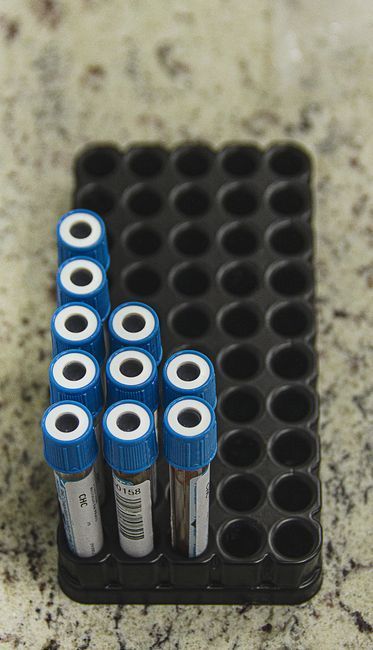
A single blood sample is all an AMH test needs. Illustrative photo.
Evidence
Is the AMH test accurate? What the research says
AMH is well studied as a predictor of response to fertility medication and much less useful for predicting natural fertility. The findings below come from large studies and professional guidance. Keep in mind that most studies involve women without known infertility or women already in IVF programs, and that AMH assays are not fully standardized, so results from different laboratories should not be compared directly.
Conceived within 12 cycles
Low AMH (<0.7 ng/mL) vs normal AMH in 750 women aged 30–44 trying naturally; low AMH did not reduce fertility.
Steiner et al., JAMA, 2017Conceived within 6 cycles
Same cohort, low vs normal AMH. Authors advise against AMH to judge natural fertility.
Steiner et al., JAMA, 2017Lower on the pill
Age-adjusted AMH difference in oral contraceptive users among 887 women; antral follicle count was 18% lower.
Birch Petersen et al., Hum Reprod, 2015pmol/L: low IVF response
NICE threshold predicting a low response to ovarian stimulation; ≥25 pmol/L predicts a high response.
NICE CG156Traveling to Seoul
AMH test in Seoul for international patients
An AMH test fits easily into a short trip. The blood draw takes a few minutes, no fasting or cycle timing is needed, and an antral follicle count can be added at the same visit. Hommage Women's Clinic is in Gangnam, a short walk from Sinnonhyeon Station (Line 9 and Shinbundang Line).
Before you come
- Message us by WhatsApp, KakaoTalk or the contact form with your dates and what you want to know, and ask for language support if needed.
- If you would like an ultrasound follicle count, try to visit early in your cycle, a few days after your period starts.
- Bring your passport, a list of medicines (including contraception) and any previous hormone or ultrasound reports.
Getting your result
Results usually arrive within a few working days. If you have already left Seoul, Dr. Park can explain them by message, and you receive a written report with the units and reference range so your doctor or fertility center at home can use it.
 Hommage · Seoul
Hommage Women's Clinic · Gangnam, Seoul
Seoul: the clinic is in Gangnam, a short walk from Sinnonhyeon Station. Illustrative photo.
 Hommage · Gangnam
Hommage Women's Clinic · Gangnam, Seoul
A good AMH service explains the number, not just reports it. Illustrative photo.
Choosing well
How to choose where to have an AMH test in Seoul
Many clinics and health-check centers in Seoul offer AMH. The blood test is similar everywhere; what differs is how well the result is explained and what happens next. Ask these questions wherever you go:
- Will a gynecologist explain the result? A number on a printout without context can cause needless worry.
- Is an ultrasound follicle count available? AMH plus AFC gives a fuller picture than either alone.
- Does the report give the unit and age-specific range? Essential if you will compare results or share them abroad.
- Is there a plan for next steps? Referral for egg freezing or IVF, PCOS care, or further hormone tests if needed.
- Do I get a written quote first? You should know what is included before the test.
What affects the cost of an AMH test in Korea?
The fee depends on whether the test is done for a medical reason or for planning, whether an ultrasound follicle count or other hormone tests are added, and whether you are enrolled in National Health Insurance. Tests done for screening or planning are often not covered, while some tests for a medical reason may be. You receive a written quote before the test.
Your visit
What to expect at your AMH appointment
01
Consultation
Dr. Park asks about your age, cycles, contraception, pregnancy plans and family history, and explains what AMH can and cannot tell you.
02
Blood test
A single blood draw on any day of your cycle. No fasting is needed.
03
Ultrasound (optional)
A pelvic ultrasound counts the small antral follicles in each ovary, which adds to the AMH result.
04
Results and plan
We review results together, usually within a few working days, and discuss timing, egg freezing or next tests if needed.

Your doctor
Dr. Park Yuna
Medical Director · OB/GYN Specialist
Dr. Park treats AMH as one piece of information rather than a fertility verdict. She explains what the test can and cannot show before you take it, then reads the result together with your age, cycles and an ultrasound so that any decision about timing or egg freezing is well informed.
OB/GYN specialist (Korea) and representative director of Hommage Clinic. Leads the clinic's women's health care, from screening and infections to hormones, contraception and fertility checks.
AMH test: frequently asked questions
What is a normal AMH level for my age?
There is no single normal value, because AMH naturally falls with age and laboratories use different assays. Your result is compared with ranges for women of your age from the same type of test. A result below the range for your age suggests lower ovarian reserve, but it does not mean you cannot conceive.
Can I take an AMH test on any day of my cycle?
Yes. AMH stays relatively stable through the menstrual cycle, so the test can be done on any day and does not require fasting. This differs from FSH and estradiol, which are timed to cycle days 2–5. If you have other hormone tests at the same visit, those may need timing.
Does birth control affect AMH results?
Hormonal contraception such as the pill, patch, ring or implant can lower AMH somewhat while you use it, and levels usually recover after stopping. The test is still often done without stopping contraception, and the doctor takes this into account when reading the result. Do not stop contraception just for the test without advice.
Can I raise my AMH level?
No treatment has been shown to increase the number of eggs you have. Supplements marketed to raise AMH have not been proven to improve fertility. A healthy weight, not smoking and managing conditions such as thyroid disease support general reproductive health, but the most useful response to a low AMH is timely planning.
Should I freeze my eggs if my AMH is low?
A low AMH may be a reason to consider egg freezing sooner, because fewer eggs are likely to be collected per cycle. The decision also depends on your age, which affects egg quality, and on your plans. Dr. Park can explain the options and refer you to a fertility center for egg freezing.
Can foreigners get an AMH test in Seoul?
Yes. International patients and foreign residents can book an AMH test at Hommage Clinic. Bring your passport, or your residence card if you are enrolled in National Health Insurance, and any previous results. Please contact us before your visit to arrange language support when you book an appointment.
Does a high AMH mean I have PCOS?
Not on its own. A high AMH often reflects many small follicles, which is common in PCOS, but the diagnosis also needs irregular or absent ovulation and/or signs of high androgens, after other causes are excluded. Under the 2023 international PCOS guideline, AMH can be used in adults instead of an ovarian ultrasound, but not in adolescents. See PCOS treatment.
Can AMH predict when I will reach menopause?
Not precisely. A very low AMH suggests fewer eggs remain, but it cannot tell you the year your periods will stop. If you have missed periods or hot flashes before 40, AMH is read with FSH and estradiol to look for premature ovarian insufficiency.
Is AMH the same as an antral follicle count?
No, but they measure similar things. AMH is a blood test; the antral follicle count is an ultrasound count of small follicles of about 2–10 mm. Professional guidance considers them broadly equivalent, and doing both at one visit gives a fuller picture. See pelvic ultrasound.
Why are AMH results different between labs?
AMH assays are not fully standardized, so different laboratory methods can give different numbers for the same blood sample. Results may also be reported in ng/mL or pmol/L (1 ng/mL is about 7.1 pmol/L). For tracking over time, it is best to use the same laboratory and compare with that lab's age ranges.
Should I repeat my AMH test?
Usually there is no need to repeat AMH often, because it changes slowly. A repeat may be useful if your first test was done while using hormonal contraception, after ovarian surgery or treatment, or when a decision about egg freezing or IVF is approaching.
Can I have an AMH test while breastfeeding or after pregnancy?
You can, but hormones are still settling after pregnancy and while breastfeeding, so the result may not reflect your usual level. If there is no urgent decision, Dr. Park may suggest waiting until your cycles have returned.
Is an AMH test useful in a premarital or pre-pregnancy check?
It can be, if you have a decision to make, such as when to start trying or whether to freeze eggs. It is optional in our premarital health check, and we explain beforehand what the result can and cannot tell you so that a single number does not cause unnecessary worry.
References
Sources used for this page, reviewed by Dr. Park Yuna, OB/GYN specialist. Read our editorial and medical review policy.
- Steiner AZ, Pritchard D, Stanczyk FZ, et al. Association between biomarkers of ovarian reserve and infertility among older women of reproductive age. JAMA. 2017;318(14):1367–1376. doi:10.1001/jama.2017.14588. JAMA
- Practice Committee of the American Society for Reproductive Medicine. Testing and interpreting measures of ovarian reserve: a committee opinion. Fertil Steril. 2020;114(6):1151–1157. ASRM
- Birch Petersen K, et al. Ovarian reserve assessment in users of oral contraception seeking fertility advice on their reproductive lifespan. Hum Reprod. 2015.
- National Institute for Health and Care Excellence. Fertility problems: assessment and treatment (CG156). Measures of ovarian reserve.
- Teede HJ, et al. Recommendations from the 2023 International Evidence-based Guideline for the Assessment and Management of Polycystic Ovary Syndrome.
This page is general information and does not replace a personal consultation. Illustrations are original works of Hommage Women's Clinic, Gangnam, Seoul; photos marked illustrative are not of patients.
Related fertility and hormone services
Hormone Testing
Cycle-timed blood tests for FSH, LH, estradiol, progesterone, thyroid and prolactin.
Ovulation Testing
Follicle-tracking ultrasound and blood tests to confirm whether and when you ovulate.
PCOS Treatment
Diagnosis and care for polycystic ovary syndrome, where AMH is often raised.
Pelvic Ultrasound
A scan of the uterus and ovaries, including the antral follicle count.
Premarital Health Check
A women's health check before marriage or pregnancy, with AMH as an optional add-on.
Low Estrogen Treatment
Care for low estrogen at any age, including early menopause and ovarian insufficiency.
Understand your ovarian reserve
Book an AMH test and consultation with Dr. Park Yuna in Gangnam. An ultrasound follicle count can be added at the same visit.
Hommage Clinic · 4F, Building A, 509 Gangnam-daero, Seoul (near Sinnonhyeon Station) · Mon & Fri 10:00–20:00 · Tue–Thu 10:00–19:00 · Sat 10:00–15:00