
Gynecology · Tests & screening
Pelvic Ultrasound in Gangnam, Seoul: What It Shows and What to Expect
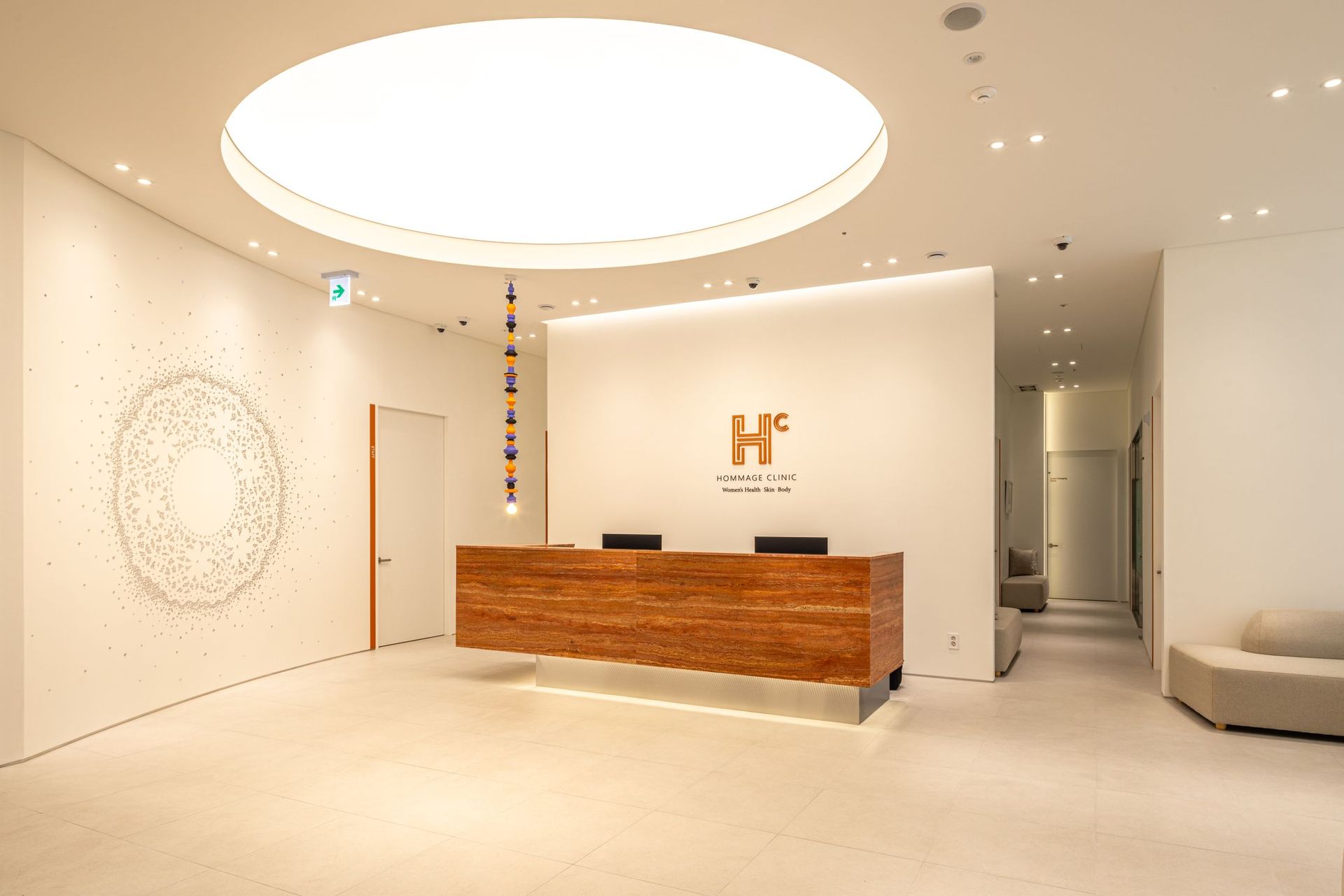
A pelvic ultrasound is a quick, radiation-free imaging test that uses sound waves to show the uterus, uterine lining, ovaries and nearby structures, either through a probe placed in the vagina or across the lower abdomen. At Hommage Clinic in Gangnam, Seoul, OB/GYN specialist Dr. Park Yuna performs the scan herself and explains what she sees during the same visit.
Quick answer
A pelvic ultrasound is a 10–15 minute, radiation-free scan of the uterus, uterine lining and ovaries, done through the vagina (transvaginal) or over the lower abdomen (transabdominal). At Hommage Women's Clinic in Gangnam, Seoul, female OB/GYN specialist Dr. Park Yuna performs the scan herself and explains the images on screen in the same visit. It is used to check pain, irregular or heavy periods, cysts, fibroids, polyps, IUD position and early pregnancy.
Key takeaways
- Transvaginal gives the clearest view; transabdominal needs no internal exam and is the usual choice if you are not sexually active.
- No radiation, no recovery time, and it can be repeated as often as needed.
- Ultrasound does not replace a Pap smear or HPV test, and it does not test for infections.
- Timing in your cycle matters for some questions, such as checking the lining or tracking ovulation.
Infographic
Pelvic ultrasound in numbers
Scan time
For the scan itself; plan a little longer for the consultation.
Radiation
Ultrasound uses sound waves, so it is safe to repeat and safe in pregnancy.
Ways to scan
Transvaginal or transabdominal; sometimes both in one visit.
Results
Dr. Park explains what she sees during your visit.
O-RADS 2 risk
Malignancy risk for findings rated “almost certainly benign” (ACR O-RADS US).
Downtime
You can return to normal activities straight away.
Pelvic ultrasound at a glance
| Key fact | Details |
|---|---|
| What it is | An imaging test using sound waves, with no radiation, to view the pelvic organs |
| Types | Transvaginal (internal, clearest view) or transabdominal (over the lower abdomen) |
| What it checks | Uterus, uterine lining, ovaries, cysts, fibroids, polyps, IUD position, early pregnancy |
| Time | Usually about 10–15 minutes for the scan itself |
| Comfort | Mild pressure; not usually painful. You can ask to stop at any time |
| Results | Explained by the doctor during the same visit |
| Performed by | Dr. Park Yuna, OB/GYN specialist |
A pelvic ultrasound is useful if you have
- Pelvic pain, painful periods or pain during sex
- Irregular, heavy or absent periods
- A cyst, fibroid or polyp that needs follow-up
- An IUD and want to check its position
- Plans for pregnancy or a routine women's health check
Seek urgent care instead if you have
- Sudden, severe pelvic pain with nausea, vomiting or fainting
- A positive pregnancy test with pain or heavy bleeding
- Heavy bleeding with dizziness or shortness of breath
What is a pelvic ultrasound?
A pelvic ultrasound uses high-frequency sound waves to create real-time images of the organs in your pelvis. A small probe sends sound waves into the body and picks up the echoes, which a computer turns into a moving picture on a screen. It uses no radiation and is considered safe, including in pregnancy.
There are two ways to do the scan:
- Transvaginal ultrasound: a slim probe, covered with a protective sheath and gel, is gently placed a short way into the vagina. Because it sits close to the uterus and ovaries, it gives the clearest, most detailed images.
- Transabdominal ultrasound: the probe moves over the lower abdomen with gel. It is used if you are not sexually active, prefer not to have an internal scan, or have a large uterus or mass that needs a wider view. A partly full bladder helps with this type of scan.
What can a pelvic ultrasound detect?
A pelvic ultrasound shows the size, shape and structure of the reproductive organs and is often the first test for gynecological symptoms. It can show:
- Uterus: fibroids , signs of adenomyosis, congenital differences in shape
- Uterine lining (endometrium): its thickness and pattern, and polyps
- Ovaries: ovarian cysts , endometriomas, the many small follicles seen in PCOS, and developing follicles for ovulation tracking
- Pregnancy: confirming the location of an early pregnancy
- IUD position: checking that an IUD sits correctly in the uterus
- Free fluid in the pelvis, which can be a sign of a ruptured cyst or infection
Ultrasound has limits. It cannot reliably show small surface patches of endometriosis , it does not test for infections, and it does not replace a Pap smear for cervical screening.
What happens during a pelvic ultrasound?
The scan itself usually takes about 10 to 15 minutes, and you can talk with the doctor throughout.
- Before the scan: Dr. Park asks about your symptoms and the first day of your last period, and explains which type of scan she recommends and why.
- Getting ready: for a transvaginal scan, you empty your bladder and undress from the waist down in private, with a drape for cover. For an abdominal scan, you may be asked to arrive with a partly full bladder.
- The scan: the probe is moved gently to view each organ from several angles. You may feel mild pressure but it should not hurt; tell us if anything is uncomfortable and we will adjust or stop.
- Results: Dr. Park shows you the images on screen, explains what they mean and, if needed, plans further tests or treatment.
You can return to normal activities straight away. There is no recovery time.
Transvaginal vs abdominal ultrasound: which is right for you?
For most adult women who are sexually active, a transvaginal scan is recommended because it gives a much clearer view of the ovaries and uterine lining. The abdominal approach is a good alternative when an internal scan is not suitable or not wanted.
- Choose transvaginal for the most detailed look at the ovaries, lining, small cysts, polyps, early pregnancy and IUD position.
- Choose transabdominal if you are not sexually active, find internal exams very distressing, or have a large fibroid or mass that extends higher in the abdomen.
Sometimes both are combined during one visit. The choice is always yours, and you can change your mind at any point.
Is a pelvic ultrasound safe? Risks and comfort
Pelvic ultrasound is a very low-risk test. It uses sound waves rather than radiation, so it can be repeated as often as needed and is safe in pregnancy. The main side effect is temporary discomfort or pressure during a transvaginal scan, especially if you have pelvic pain, vaginal dryness or anxiety about internal exams. Light spotting afterwards is uncommon and usually minor.
Each probe is covered with a new single-use sheath and cleaned between patients. If you have a latex allergy, tell us beforehand so a latex-free cover is used. As with any imaging test, ultrasound can occasionally show findings that need further tests to clarify, or miss very small changes. Contact the clinic if you develop pain, fever or heavier bleeding after your scan.
Pelvic ultrasound at Hommage Clinic
Hommage Clinic is a women's clinic in Gangnam, a short walk from Sinnonhyeon Station. Pelvic ultrasounds are performed by Dr. Park Yuna, a female OB/GYN specialist, rather than by a separate technician, so the doctor who examines you is also the one who interprets the images and explains them to you. Ultrasound can be combined with other tests, such as hormone testing or a well-woman exam , in the same visit.
If you are enrolled in Korea's National Health Insurance, pelvic ultrasound is covered when there is a medical reason such as symptoms or follow-up of a known condition; scans done purely as part of a general check-up may not be covered. Visitors without coverage pay the clinic's fees directly, and we explain costs before the scan. See all our gynecology services .
Two approaches
Transvaginal vs transabdominal ultrasound, side by side
Sound waves lose detail the further they travel. A transvaginal probe sits only a few centimetres from the uterus and ovaries, so it shows small structures such as follicles, polyps and the lining in fine detail. A transabdominal probe looks through the abdominal wall and the bladder, so the view is wider but less detailed. This is why a full bladder helps the abdominal scan: it acts as a window and pushes the bowel aside. The diagram and table below compare the two.
| Compare | Transvaginal | Transabdominal |
|---|---|---|
| Image detail | Highest; small follicles, polyps and lining | Wider view, less fine detail |
| Bladder | Empty | Partly full |
| Internal exam | Yes, a slim covered probe | No |
| Best for | Cysts, lining, polyps, IUD, early pregnancy, follicle tracking | Not sexually active, large fibroids or masses, preference |
| Comfort | Mild pressure; can stop any time | Gel on the skin; full bladder can feel uncomfortable |
Reading the scan
What a pelvic ultrasound shows: a visual guide
During the scan, Dr. Park checks each organ in turn and measures anything that needs follow-up. The diagram shows where common findings appear. Many of them, such as small follicles, a functional cyst or a small fibroid, are normal or harmless, and part of the explanation is telling you what does not need treatment.
When an ovarian cyst is seen, many clinicians describe it with O-RADS US, a scoring system from the American College of Radiology. A simple cyst is usually category 2, “almost certainly benign”. Read more on ourovarian cystpage.
 Hommage · Gangnam
Hommage Women's Clinic · Gangnam, Seoul
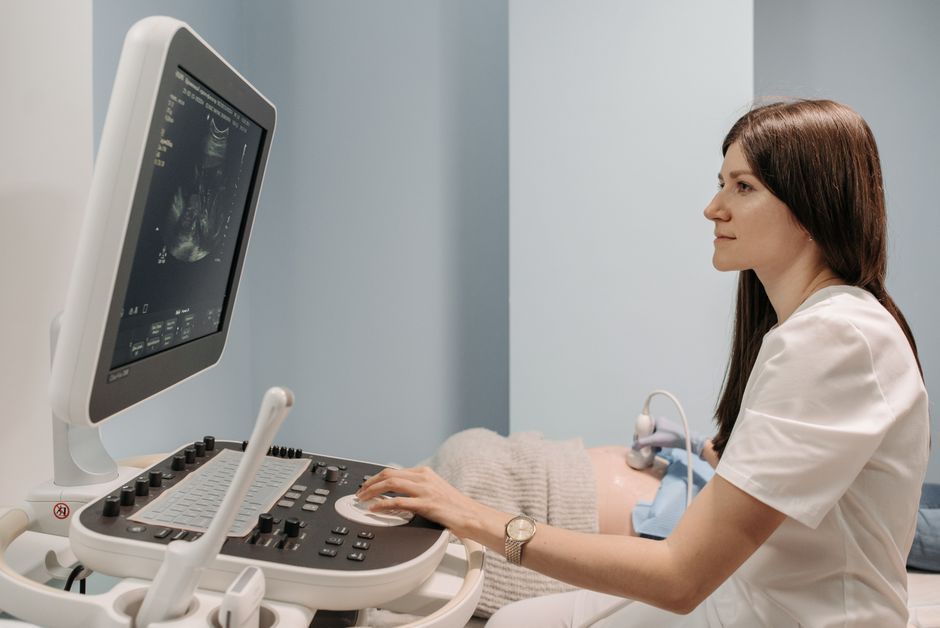
You can watch the screen while the scan is explained. Illustrative photo.
Timing
Best time in your cycle for a pelvic ultrasound
A pelvic ultrasound can be done on any day, including during your period. For some questions, though, the day of your cycle makes the answer clearer. The lining is thinnest just after a period, so polyps and lining problems stand out best then. Follicles grow in the first half of the cycle, soovulation trackingis timed to that window. A functional ovarian cyst is often rechecked in a different phase of the cycle to see whether it has gone. If you have pain or bleeding now, do not wait for the “right” day.
 Hommage · Gangnam
Hommage Women's Clinic · Gangnam, Seoul
For an abdominal scan, drinking water beforehand gives a clearer view. Illustrative photo.
Preparation
How to prepare for a pelvic ultrasound
There is very little to do before a pelvic ultrasound, and you do not need to fast. The main difference is your bladder: empty for a transvaginal scan, partly full for a transabdominal scan. If you are not sure which you will have, tell us when you book and we will advise you. Wearing a skirt or two-piece outfit makes changing easier, and you are always given privacy and a drape.
Transvaginal scan
- Empty your bladder just before the scan
- No need to fast or avoid sex beforehand
- Can be done during your period
- Tell us about a latex allergy
- Tampon or menstrual cup out before the scan
Transabdominal scan
- Drink water so your bladder is partly full
- Avoid emptying your bladder just before
- Wear clothing that lets you uncover your lower abdomen
- Gel is wiped off afterwards
- No internal exam needed
Evidence
Pelvic ultrasound: what the guidelines say
Ultrasound is the first-line imaging test in gynecology, and international guidelines rely on it to decide what happens next. The cards below show how it is used in three common situations. Ultrasound is operator-dependent: the quality of the machine and the experience of the person scanning both matter, and some findings need MRI or repeat scans to clarify.
O-RADS US categories
From a normal ovary (1) to high risk (5); category 2 is under 1% risk.
American College of Radiology, O-RADS US v2022Simple cyst, no symptoms
Before menopause, generally no further scan needed.
RCOG Green-top Guideline 62Follicles per ovary
Ultrasound threshold for polycystic ovaries in adults; not used in teens.
International PCOS Guideline 2023When a cyst is clearly simple
A blood test is not needed if ultrasound shows a simple cyst.
RCOG Green-top Guideline 62Ultrasound rules for ovarian masses
Pooled sensitivity and specificity of the IOTA Simple Rules for telling benign from malignant masses (27 studies, 7,841 masses); the rules could be applied to about 86% of masses, the rest needed expert review.
Gareeballah et al., Front Oncol 2024 (systematic review & meta-analysis)Traveling to Seoul
Pelvic ultrasound in Seoul for international patients
A pelvic ultrasound is one of the easiest tests to fit into a short stay in Seoul: there is no preparation beyond your bladder, no recovery time, and the results are explained the same day. Many visitors use it for a second opinion on a cyst or fibroid found at home, a check before trying to conceive, or as part of awell-woman exam.
Before you visit
- Book by WhatsApp, KakaoTalk or the contact form, and tell us the reason for the scan and any language needs.
- Bring earlier scan reports and images so changes can be compared.
- Note the first day of your last period, and tell us if you have an IUD.
- Bring your passport for registration.
After your scan
You can ask for a written report to take home for your own doctor. If follow-up is needed, it can be done at Hommage on a later visit or at home using that report.
 Hommage · Seoul
Hommage Women's Clinic · Gangnam, Seoul
Seoul: the clinic is in Gangnam, a short walk from Sinnonhyeon Station. Illustrative photo.
 Hommage · Gangnam
Hommage Women's Clinic · Gangnam, Seoul
The person scanning should be able to explain the images to you directly. Illustrative photo.
Choosing well
How to choose where to have a pelvic ultrasound in Seoul
Because ultrasound depends on the person scanning, it is worth asking a few questions wherever you book:
- Who performs the scan? An OB/GYN specialist can scan, interpret and plan treatment in one visit.
- Can I choose the type of scan? You should be offered an abdominal scan if you prefer not to have an internal one.
- Will I see and understand the images? A clear explanation on screen avoids confusion later.
- Can I get a written report? Useful for follow-up at home or with another doctor.
- Is follow-up with the same doctor possible? Comparing scans over time is easier with the same person.
What affects the cost of a pelvic ultrasound?
Cost depends on whether you are enrolled in Korea's National Health Insurance and whether the scan has a medical reason (symptoms or follow-up) or is part of a general check-up, which may not be covered. Adding tests such ashormone testingor aPap smearin the same visit also changes the total. We explain the costs before the scan.
Feeling at ease
Nervous about a transvaginal ultrasound? What helps
Many women feel anxious before their first internal scan, especially after a painful exam in the past, with conditions such as vaginismus or endometriosis, or when visiting a clinic in a new country. That is normal, and you stay in control throughout.
- The scan is done by a female doctor, with a drape for cover and privacy to undress.
- Tell the doctor what has been difficult before, so she can go slowly and explain each step.
- Plenty of gel is used, and a smaller movement range is possible if you have pain.
- You can ask to pause or stop at any time, and switch to an abdominal scan.
- If you would like someone with you, ask when you book.
If you have pain during sex or with exams, tell us when you book so we can allow more time. See alsopelvic pain treatment.
 Hommage · Gangnam
Hommage Women's Clinic · Gangnam, Seoul
You choose the type of scan and can stop at any time. Illustrative photo.
Your visit
Your pelvic ultrasound, step by step
01
Book
Tell us the reason for the scan and the first day of your last period. Bring any previous scan reports.
02
Consultation
Dr. Park reviews your symptoms and agrees with you whether a transvaginal or abdominal scan suits you.
03
Scan
The scan takes about 10–15 minutes in a private room, with a drape for cover. You can ask to stop at any time.
04
Results and plan
Dr. Park explains the images on screen and plans any follow-up, treatment or further tests.

Your doctor
Dr. Park Yuna
Medical Director · OB/GYN Specialist
Dr. Park performs pelvic ultrasounds herself and talks you through the images as she scans. She explains what is normal, what needs follow-up and why, and always respects your choice of scan type.
OB/GYN specialist (Korea) and representative director of Hommage Clinic. Leads the clinic's women's health care, from screening and infections to hormones, contraception and fertility checks.
Pelvic ultrasound: frequently asked questions
Does a transvaginal ultrasound hurt?
A transvaginal ultrasound is usually not painful. Most women feel mild pressure, similar to inserting a tampon. It may be more uncomfortable if you have pelvic pain or endometriosis. Tell the doctor if it hurts; the probe can be adjusted, the scan can stop at any time, and an abdominal scan is an alternative.
Do I need a full bladder for a pelvic ultrasound?
For a transvaginal ultrasound you need an empty bladder, so you will be asked to use the toilet first. For a transabdominal ultrasound, a moderately full bladder helps push the bowel aside and gives a clearer view, so you may be asked to drink water beforehand. We will tell you which applies when you book.
Can I have a pelvic ultrasound during my period?
Yes. A pelvic ultrasound can be done during your period, and a transvaginal scan is still possible. For some questions, such as measuring the lining or checking for polyps, a scan just after your period gives clearer results, so the doctor may suggest a specific day in your cycle.
Can a pelvic ultrasound detect cancer?
A pelvic ultrasound can show changes that may need further investigation, such as a thickened uterine lining or an ovarian cyst with solid areas. It cannot confirm cancer on its own; that requires tests such as a biopsy. It also does not screen for cervical cancer, which needs a Pap smear or HPV test.
Can I have a pelvic ultrasound if I have never had sex?
Yes. A transabdominal ultrasound, done over the lower abdomen, does not require any internal examination and is the usual choice if you are not sexually active. It gives good views of the uterus and ovaries in most cases. Let us know when you book so we can prepare.
Can foreigners get a pelvic ultrasound in Seoul?
Yes. Foreign residents and visitors can book a pelvic ultrasound at Hommage Clinic; bring your passport or alien registration card to register. If you are enrolled in National Health Insurance, scans for a medical reason are generally covered. Please contact us before your visit to arrange language support.
How long does a pelvic ultrasound take?
The scan itself usually takes about 10 to 15 minutes. Allow extra time for the consultation beforehand and for Dr. Park to explain the results. If you need a transabdominal scan, you may also need time to fill your bladder.
Can a pelvic ultrasound detect endometriosis?
It can show endometriomas (“chocolate cysts”) on the ovaries and sometimes deeper endometriosis, but it cannot reliably show small surface patches. A normal ultrasound therefore does not rule out endometriosis if your symptoms suggest it.
Can ultrasound diagnose PCOS?
Ultrasound is one part of the diagnosis. In adults, 20 or more follicles in at least one ovary counts as polycystic ovarian morphology, but PCOS also needs irregular ovulation or signs of raised androgens. Ultrasound is not used to diagnose PCOS in teenagers.
Can I have a pelvic ultrasound with an IUD?
Yes. Ultrasound is the usual way to check that an IUD is in the right place, for example if you cannot feel the threads or have new pain or bleeding. The scan does not move the IUD.
Is pelvic ultrasound safe in early pregnancy?
Yes. Ultrasound uses sound waves, not radiation. In early pregnancy, a transvaginal scan is often used to confirm that the pregnancy is inside the uterus. If you have a positive test with pain or bleeding, seek care promptly.
Will I get my pelvic ultrasound results the same day?
Yes. Dr. Park performs the scan herself and explains what she sees during the visit. If further tests are needed, such as blood tests or a repeat scan, she will explain why and when.
Is a pelvic ultrasound the same as a Pap smear?
No. A pelvic ultrasound images the uterus and ovaries, while a Pap smear or HPV test collects cells from the cervix to screen for cervical cancer. They answer different questions and can be done in the same visit.
References
Sources used for this page, reviewed by Dr. Park Yuna, OB/GYN specialist. Read our editorial and medical review policy.
- American College of Radiology. O-RADS US risk stratification and management system (v2022). Summary
- Royal College of Obstetricians and Gynaecologists. Management of suspected ovarian masses in premenopausal women. Green-top Guideline No. 62. 2011.
- Teede HJ, et al. Recommendations from the 2023 International Evidence-based Guideline for the Assessment and Management of Polycystic Ovary Syndrome. Hum Reprod. 2023;38(9):1655–1679. Full text
- Gareeballah A, et al. The diagnostic performance of International Ovarian Tumor Analysis: Simple Rules for diagnosing ovarian tumors — a systematic review and meta-analysis. Front Oncol. 2024;14:1474930. doi:10.3389/fonc.2024.1474930. Full text
This page is general information and does not replace a personal consultation. Illustrations are original works of Hommage Women's Clinic, Gangnam, Seoul; photos marked illustrative are not of patients.
Related women's health services
Ovarian Cyst Treatment
Monitoring and treatment of cysts found on ultrasound.
Uterine Fibroid Treatment
Follow-up and treatment for fibroids that cause heavy or painful periods.
Well-Woman Exam
A routine women's health check that can include ultrasound and screening tests.
Hormone Testing
Blood tests that, with ultrasound, help explain cycle and fertility changes.
Pelvic Pain Treatment
Finding the cause of acute or chronic pelvic pain.
Pap Smear
Cervical screening, which a pelvic ultrasound does not replace.
Book a pelvic ultrasound with a female OB/GYN
Dr. Park Yuna performs and explains your scan in the same visit at our Gangnam clinic near Sinnonhyeon Station.
Hommage Clinic · 4F, Building A, 509 Gangnam-daero, Seoul (near Sinnonhyeon Station) · Mon & Fri 10:00–20:00 · Tue–Thu 10:00–19:00 · Sat 10:00–15:00