
Gynecology · Urinary health
UTI Treatment in Gangnam: Cystitis, Kidney Infection and Prevention
A urinary tract infection (UTI) is a bacterial infection of the bladder (cystitis) or, less often, the kidneys, causing burning when you pee, a frequent urge to urinate and lower abdominal pain; most bladder infections clear within days with a short course of antibiotics. At Hommage Clinic in Gangnam, Seoul, female OB/GYN specialist Dr. Park Yuna confirms a UTI with a urine test and helps prevent recurrence.

Quick answer
UTI treatment for a bladder infection (cystitis) is a short course of antibiotics, from a single dose to about 7 days, after a urine test confirms infection; symptoms usually ease within 1–2 days. At Hommage Women's Clinic in Gangnam, Seoul, female OB/GYN specialist Dr. Park Yuna tests your urine, rules out vaginal infections and STIs that mimic a UTI, and plans prevention if UTIs keep returning.
Key takeaways
- About half of all women have at least one UTI in their lifetime.
- Fever, chills, back or side pain or vomiting suggest a kidney infection: seek care the same day.
- A urine culture is used for recurrent UTIs, pregnancy or when treatment fails.
- Recurrent UTIs can often be reduced with water, vaginal estrogen after menopause or preventive medicines.
Infographic
UTIs in numbers
Lifetime risk
Women with at least one UTI.
Relief
Typical time for symptoms to ease on antibiotics.
Cystitis course
From a single dose to about a week.
Kidney infection
Longer treatment, sometimes in hospital.
Recurrent UTI
Or three or more in a year.
Extra water a day
Halved recurrences in low-drinkers in a trial.
UTI care at a glance
| Key fact | Details |
|---|---|
| What it is | A bacterial infection of the bladder (cystitis) or kidneys, most often caused by E. coli |
| Common signs | Burning when you pee, frequent or urgent need to go, lower belly pain, cloudy or bloody urine |
| How it's diagnosed | Symptoms plus a urine dipstick test; a urine culture for recurrent, complicated or pregnancy UTIs |
| Treatment | Antibiotics, usually a single dose to 7 days for cystitis, longer for a kidney infection |
| Relief | Symptoms usually start to improve within 1–2 days of starting antibiotics |
| Urgent signs | Fever, chills, back or side (flank) pain, vomiting, or UTI symptoms in pregnancy |
| Reviewed by | Dr. Park Yuna, OB/GYN specialist |
Book an appointment if you have
- Burning or stinging when you pee, or needing to go often with little urine
- Blood in your urine without fever or back pain
- Two or more UTIs in 6 months, or three or more in a year
- UTIs that start after sex, or that began around menopause
- Burning with unusual vaginal discharge or itching
Seek urgent care instead if you have
- Fever, chills or pain in your back or side, below the ribs
- Nausea or vomiting with urinary symptoms, or feeling very unwell or confused
- UTI symptoms during pregnancy: contact your prenatal doctor or an emergency room the same day
What is a UTI? Bladder infection vs kidney infection
A UTI happens when bacteria, usually E. coli from the bowel, enter the urethra and multiply in the urinary tract. Women get UTIs far more often than men because the urethra is short and close to the vagina and anus. About half of all women have at least one UTI in their lifetime.
Bladder infection (cystitis)
- Burning or pain when you pee
- Needing to pee often or urgently, passing only small amounts
- Pressure or pain low in the abdomen
- Cloudy, strong-smelling or bloody urine
Kidney infection (pyelonephritis)
- Fever and chills
- Pain in the back or side, below the ribs (flank pain)
- Nausea or vomiting and feeling generally unwell
- Bladder symptoms may or may not be present
A bladder infection is common and usually easy to treat. A kidney infection is more serious, needs prompt antibiotics, and sometimes needs hospital care. Common triggers include sex, spermicides, holding urine for long periods, not drinking enough, pregnancy, diabetes and the lower estrogen levels after menopause.
How is a UTI diagnosed, and could it be something else?
A UTI is diagnosed from your symptoms and a urine test. You give a clean-catch, midstream urine sample, and a dipstick checks for white blood cells and nitrites, signs of infection. A urine culture identifies the bacteria and the antibiotics that work against them. A culture is recommended if UTIs keep coming back, if you are pregnant, if a kidney infection is suspected or if treatment has not worked. Tell us if you have already taken any antibiotics, as this can affect the result.
Burning when you pee does not always mean a UTI. Vaginal infections such as yeast or trichomoniasis, sexually transmitted infections such as chlamydia, gonorrhea or herpes, and thinning of the vaginal tissue after menopause can all cause similar discomfort. If you also have unusual discharge, itching or a new partner, a swab test may be added. See our pages on vaginal infections and STD testing for more.
UTI treatment: which antibiotic, and for how long?
Most bladder infections are treated with a short course of antibiotics, and symptoms usually ease within one to two days. Options that international guidelines recommend for uncomplicated cystitis include:
- Nitrofurantoin , usually for 5 days.
- Fosfomycin , a single dose.
- Pivmecillinam , trimethoprim-sulfamethoxazole or an oral cephalosporin in some cases, usually for 3–7 days.
The choice depends on your allergies, whether you could be pregnant, your past culture results, which medicines are available and antibiotic resistance patterns in Korea, where resistance of E. coli to some common antibiotics is relatively high. Fluoroquinolones such as ciprofloxacin are generally kept for more serious infections because of their side effects. A kidney infection needs a longer course, usually 7–14 days depending on the medicine, and an injection or hospital treatment if you are very unwell or vomiting.
Drink fluids, rest and take simple pain relief if needed. Take every dose as prescribed, and do not use leftover antibiotics from a previous infection. Bacteria in the urine without symptoms is not usually treated, except in pregnancy.
How can you prevent recurrent UTIs?
Recurrent UTIs, defined as two or more infections in 6 months or three or more in a year, can often be reduced with a combination of habits and medical options:
- Drink more water if you usually drink little; a clinical trial found that about 1.5 liters of extra water a day halved recurrences in such women.
- Pee soon after sex and avoid holding urine for long periods.
- Avoid spermicides and diaphragms if UTIs follow sex; consider other birth control options .
- Vaginal estrogen after menopause restores the protective vaginal environment and reduces recurrent UTIs. See our page on vaginal dryness .
- Cranberry products may modestly lower the chance of repeat infections, although they do not treat an active UTI.
- Preventive medicines , such as methenamine hippurate or a low-dose antibiotic taken daily or after sex for several months, for women with frequent infections.
D-mannose and probiotics are popular, but evidence that they prevent UTIs is limited or mixed.
UTIs in pregnancy and when to seek urgent care
A UTI in pregnancy needs prompt treatment, because it is more likely to spread to the kidneys and is linked with preterm birth. Pregnant women are usually screened with a urine culture early in pregnancy and treated even without symptoms. Antibiotics are chosen for safety in pregnancy, for example a cephalosporin or amoxicillin-clavulanate, while some medicines are avoided at certain stages. If you are pregnant and have UTI symptoms, contact your prenatal doctor the same day.
Go to an emergency room straight away if you have fever with chills, back or flank pain, vomiting, confusion, or you feel faint. These can be signs of a kidney infection, which can spread into the blood if untreated.
Possible side effects of UTI treatment
Antibiotics for UTIs are usually well tolerated, but side effects can occur. Nausea, diarrhea and headache are the most common, and a vaginal yeast infection can follow a course of antibiotics. Nitrofurantoin can turn urine dark yellow or brown, which is harmless; rare lung or liver reactions occur mainly with long-term use. Trimethoprim-sulfamethoxazole can cause rashes and sun sensitivity, and rarely severe skin reactions. Fluoroquinolones can, rarely, cause tendon, nerve or heart-rhythm problems.
Overuse of antibiotics also drives resistance, which is why we confirm the diagnosis and use a culture for recurrent infections. Contact the clinic if you are not improving within 48 hours, develop a rash or severe diarrhea, or notice fever or back pain.
UTI treatment at Hommage Clinic
Hommage Clinic is a women's clinic in Gangnam, a short walk from Sinnonhyeon Station, and welcomes walk-ins during opening hours. Dr. Park Yuna, a female OB/GYN specialist, reviews your symptoms, tests your urine and can check for vaginal infections or STIs at the same visit when symptoms overlap. For recurrent UTIs, she can also assess menopause-related changes and pelvic floor problems. You can find our othergynecology serviceshere.
If you are enrolled in Korea's National Health Insurance, the consultation, urine tests and prescribed antibiotics are usually covered in part; visitors without coverage pay the clinic's fees directly. We explain costs before tests are done.
How a UTI spreads
Bladder infection vs kidney infection: where a UTI happens
Most UTIs start low in the urinary tract. Bacteria enter through the urethra and multiply in the bladder, causing cystitis: burning, frequency and lower belly pain. If they travel further up the ureters to the kidneys, the infection becomes pyelonephritis, which causes fever, chills, back or side pain and vomiting.
The diagram shows this path in simplified form. The key message: bladder symptoms alone can usually be treated in the clinic, but fever or flank pain needs same-day care, and a kidney infection in pregnancy is always urgent.
 Hommage · Gangnam
Hommage Women's Clinic · Gangnam, Seoul
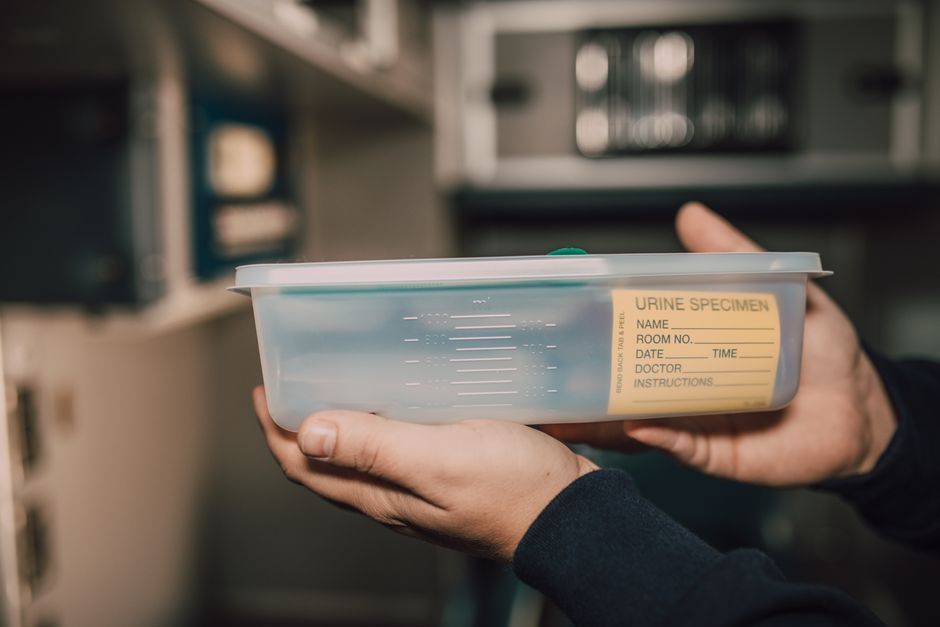
A clean-catch urine sample is tested during your visit. Illustrative photo.
Burning when you pee
UTI vs vaginal infection vs STI: what is causing the burning?
Burning when you pee is one of the most common reasons women see a gynecologist, and it is not always a UTI. Burning felt inside, with a frequent urge to go, points to the bladder. Burning felt on the skin as urine passes, with itching or unusual discharge, points to a vaginal infection . Bleeding after sex, a new partner or pelvic pain raise the possibility of an STI such as chlamydia. After menopause, thin, dry tissue can cause both burning and repeated UTIs. That is why a women's clinic often tests urine and, when needed, a vaginal swab at the same visit.
| Cause | Typical clues | Test | Treatment |
|---|---|---|---|
| UTI (cystitis) | Burning inside, frequency, urgency, cloudy urine | Urine dipstick, culture if needed | Short antibiotic course |
| Vaginal infection | Itching, discharge, burning on skin | Swab, pH, microscopy | Antifungal or antibiotic |
| STI | New partner, bleeding after sex, pelvic pain | PCR swab or urine | Antibiotics; partner treated |
| Low estrogen | Dryness, soreness, repeat UTIs after menopause | Exam | Vaginal estrogen, moisturizers |
Recurrent UTIs
Recurrent UTI prevention: a step-by-step plan
For women with two or more UTIs in 6 months, or three or more in a year, prevention usually starts with simple, low-risk steps and moves up only if infections continue. Each step below is drawn from the options described on this page; Dr. Park adapts the order to your triggers, age and plans for pregnancy, and uses a urine culture to guide any antibiotic.
 Hommage · Gangnam
Hommage Women's Clinic · Gangnam, Seoul
Extra water helps most if you usually drink little. Illustrative photo.
Self-care
What to do during UTI treatment: do's and don'ts
Antibiotics do the main work, but a few simple steps make the next few days more comfortable and help you spot a problem early. Most women feel better within one to two days; if you do not, or you develop fever or back pain, contact us.
Do
- Take every antibiotic dose as prescribed
- Drink fluids and rest
- Use simple pain relief if needed
- Pee when you feel the urge, and soon after sex
- Call us if not better within 48 hours
Don't
- Use leftover antibiotics from a past infection
- Rely on cranberry juice to treat an active UTI
- Ignore fever, chills, back or side pain
- Hold urine for long periods
- Wait if you are pregnant: call the same day
Evidence
UTI treatment and prevention: what the research says
Uncomplicated bladder infections in women are among the best-studied infections in medicine, and short antibiotic courses work well for most. Prevention research is more mixed: some measures, such as extra water for women who drink little and vaginal estrogen after menopause, have stronger support than others.
UTIs in one year
Average number of UTIs with extra water vs usual intake, in a 12-month randomized trial of 140 premenopausal women with recurrent UTIs.
Hooton et al., JAMA Intern Med, 2018Extra water a day
Added to usual intake in women who drank little and had at least 3 UTIs in the year before. About half as many UTIs followed.
Hooton et al., JAMA Intern Med, 2018 Hommage · Gangnam
Hommage Women's Clinic · Gangnam, Seoul
A urine culture guides antibiotic choice for recurrent UTIs. Illustrative photo.
Traveling or living in Seoul
UTI treatment in Seoul for travelers and expats
UTIs often start on trips, with long flights, less water, holding urine and new routines. A single visit usually covers it: a urine test at the clinic, a short antibiotic course you can finish while traveling, and a culture sent to the lab when needed. If culture results arrive after you leave, we share them privately and tell you if the antibiotic should change.
Before your visit
- Message us by WhatsApp, KakaoTalk or the contact form with your travel dates; ask for language support if needed.
- Bring the names of any antibiotics you have already taken, and your allergies.
- Tell us if you could be pregnant.
When to go to a hospital instead
Fever, chills, back or side pain, vomiting or confusion suggest a kidney infection. Go to a hospital emergency room straight away, and if you are pregnant with UTI symptoms, seek care the same day.
 Hommage · Gangnam
Hommage Women's Clinic · Gangnam, Seoul
Walk-ins are welcome during opening hours. Illustrative photo.
 Hommage · Gangnam
Hommage Women's Clinic · Gangnam, Seoul
A prevention plan is made for women with repeated UTIs. Illustrative photo.
Choosing well
How to choose a clinic for recurrent UTIs in Seoul
Use these questions at any clinic, including ours:
- Is your urine tested before antibiotics? A dipstick at least, and a culture for recurrent UTIs.
- Are vaginal infections and STIs considered? They often mimic a UTI.
- Is antibiotic resistance taken into account? Especially important in Korea.
- Is there a prevention plan? Habits, triggers, estrogen and medicines, not just repeat antibiotics.
- Are menopause and pelvic floor issues assessed? Both are linked to repeat UTIs.
- Are costs explained before tests? Including culture.
What affects the cost of UTI treatment in Seoul?
Cost depends on whether a dipstick alone is enough or a culture is sent, whether a vaginal swab or STD testing is added, the antibiotic prescribed and, for recurrent UTIs, follow-up visits and preventive treatment such as vaginal estrogen. For patients enrolled in National Health Insurance, consultation, urine tests and antibiotics are usually partly covered; visitors without coverage pay directly. We explain costs before tests are done.
Your visit
What to expect at your UTI appointment
01
Consultation
Dr. Park asks about your symptoms, past UTIs, sex and contraception, menopause, pregnancy and any antibiotics already taken.
02
Urine test
A clean-catch urine sample is tested at the visit, with a culture sent to the lab when needed. A swab is added if vaginal symptoms overlap.
03
Treatment
An antibiotic chosen for your situation, with clear instructions and advice on what to expect over the next few days.
04
Follow-up
Contact us if you are not better within 48 hours. For recurrent UTIs, we plan prevention and review culture results.

Your doctor
Dr. Park Yuna
Medical Director · OB/GYN Specialist
Dr. Park first checks whether burning and frequency come from the bladder or from a vaginal infection or STI, so the right treatment is given. For women with repeated UTIs, she looks for triggers such as sex, contraception or menopause-related changes and builds a prevention plan that uses antibiotics only when they are needed.
OB/GYN specialist (Korea) and representative director of Hommage Clinic. Leads the clinic's women's health care, from screening and infections to hormones, contraception and fertility checks.
UTIs: frequently asked questions
Can a UTI go away on its own?
Some mild bladder infections settle without antibiotics within about a week, but there is a small risk the infection spreads to the kidneys. Antibiotics relieve symptoms faster and lower that risk. Do not wait if you have fever, back pain or vomiting, or if you are pregnant; these need prompt medical care.
How long does a UTI last with antibiotics?
Most women feel better within one to two days of starting antibiotics, and symptoms usually clear within about three days. Keep taking every dose as prescribed. If you are not improving after 48 hours, or symptoms come back soon after finishing, contact the clinic so a urine culture can check which antibiotic will work.
Is a UTI a sexually transmitted infection?
No. A UTI is caused by your own bowel bacteria entering the urethra, and it is not passed between partners like an STI. However, sex can trigger UTIs, and some STIs, such as chlamydia, cause burning that feels like a UTI. If you have a new partner or unusual discharge, ask about STD testing.
Why do I get a UTI after sex?
Sex can push bacteria toward the urethra, which is why some women get UTIs soon after intercourse. Peeing soon after sex, drinking enough water and avoiding spermicides can help. If UTIs keep following sex, a single low-dose antibiotic taken after intercourse is an option that Dr. Park can discuss with you.
Does cranberry juice cure a UTI?
No. Cranberry products do not treat an active UTI, so you still need antibiotics if you have an infection. For women with frequent UTIs, cranberry capsules or juice may modestly lower the chance of future infections. Sugar-free products or capsules are a better choice than sweetened juice.
When is a UTI an emergency?
A UTI becomes urgent if you have fever, chills, back or side pain, vomiting or confusion, as these suggest a kidney infection that can spread to the blood. Go to an emergency room straight away in these cases. UTI symptoms in pregnancy should also be checked by a doctor the same day.
Can foreigners get UTI treatment in Seoul?
Yes. International patients and foreign residents can book UTI testing and treatment at Hommage Clinic in Gangnam. Bring your passport or residence card and the names of any antibiotics you have already taken. If you are traveling, we can choose a short course that fits your plans. Contact us before your visit to arrange language support.
How is a UTI diagnosed?
From your symptoms and a clean-catch urine sample. A dipstick checks for white blood cells and nitrites, and a urine culture identifies the bacteria and which antibiotics work. A culture is recommended for recurrent UTIs, in pregnancy, if a kidney infection is suspected or if treatment has not worked.
What is the difference between a bladder infection and a kidney infection?
A bladder infection (cystitis) causes burning, frequent urination and lower belly pain and is usually treated with a short antibiotic course. A kidney infection (pyelonephritis) adds fever, chills, back or side pain and vomiting; it needs prompt treatment, a longer course of usually 7–14 days, and sometimes hospital care.
What counts as recurrent UTIs?
Two or more UTIs in 6 months, or three or more in a year. Recurrent UTIs are worth a fuller review: a urine culture, a look at triggers such as sex, spermicides or menopause, and a prevention plan that may include more water, vaginal estrogen or preventive medicine.
Does drinking more water prevent UTIs?
It can help if you usually drink little. A clinical trial found that about 1.5 liters of extra water a day roughly halved repeat UTIs in women who drank small amounts. Drinking more is unlikely to add much benefit if you already drink plenty.
Can vaginal estrogen prevent UTIs after menopause?
Yes, for many women. Lower estrogen after menopause changes the vaginal environment and makes UTIs more likely. Vaginal estrogen restores the protective environment and reduces recurrent UTIs. Dr. Park can discuss whether it suits you.
Why is burning when I pee not always a UTI?
Vaginal infections such as yeast or trichomoniasis, STIs such as chlamydia, gonorrhea or herpes, and thin vaginal tissue after menopause can all cause burning. If you also have discharge, itching or a new partner, a swab may be added to the urine test so the right cause is treated.
References
Sources used for this page, reviewed by Dr. Park Yuna, OB/GYN specialist. Read our editorial and medical review policy.
- Hooton TM, Vecchio M, Iroz A, et al. Effect of increased daily water intake in premenopausal women with recurrent urinary tract infections: a randomized clinical trial. JAMA Intern Med. 2018;178(11):1509–1515. Summary: American Family Physician.
- Gupta K, Hooton TM, Naber KG, et al. International clinical practice guidelines for the treatment of acute uncomplicated cystitis and pyelonephritis in women: a 2010 update by the IDSA and ESCMID. Clin Infect Dis. 2011;52(5):e103–e120. doi:10.1093/cid/ciq257
- American Urological Association / CUA / SUFU. Recurrent uncomplicated urinary tract infections in women: AUA/CUA/SUFU guideline. Published 2019; validity confirmed 2022; amended 2025.
This page is general information and does not replace a personal consultation. Illustrations are original works of Hommage Women's Clinic, Gangnam, Seoul; photos marked illustrative are not of patients.
Related women's health services
Vaginal Infections
Burning with discharge or itching may be BV, yeast or trichomoniasis rather than a UTI.
STD Testing
Confidential tests for chlamydia, gonorrhea and other infections that can mimic a UTI.
Vaginal Dryness
Low estrogen after menopause and its link with irritation and recurrent UTIs.
Urinary Incontinence
Leaking urine with coughing, exercise or urgency: causes and treatment options.
Menopause Treatment
A personal care plan for hot flashes, sleep, vaginal and urinary symptoms.
Pelvic Pain Treatment
Lower abdominal pain that is not a UTI: causes, tests and when it is urgent.
Get relief from UTI symptoms
Book with Dr. Park Yuna near Sinnonhyeon Station for a urine test, the right antibiotic and a plan to stop UTIs from coming back.
Hommage Clinic · 4F, Building A, 509 Gangnam-daero, Seoul (near Sinnonhyeon Station) · Mon & Fri 10:00–20:00 · Tue–Thu 10:00–19:00 · Sat 10:00–15:00