
Skin & Aesthetics · Acne scars
Ice Pick Scar Treatment: Targeting Narrow, Deep Acne Scars
Ice pick scar treatment targets ice pick scars, the narrow, deep acne scars that look like small punctures or enlarged pores, by working on each scar individually rather than on the whole skin surface. At Hommage Clinic in Gangnam, Seoul, Dr. Hwang Seonhwa usually treats them with TCA CROSS or punch techniques first, then blends the surrounding skin with RF microneedling or fractional laser.

Quick answer
Ice pick scar treatment works on each narrow, deep acne scar individually, because laser and microneedling spread across the skin rarely reach their base. At Hommage Women's Clinic in Gangnam, Seoul, Dr. Hwang Seonhwa usually uses TCA CROSS, typically 2–4 sessions about 4–8 weeks apart, and considers punch excision for wider or very deep scars, then blends the surrounding skin with RF microneedling or fractional laser. Scars become shallower over months but are not erased.
Key takeaways
- Ice pick scars are narrow (under 2 mm) but deep, so they need a targeted method.
- They are the most common acne scar type, estimated at 60–70% of depressed scars.
- TCA CROSS is the usual first choice; punch techniques suit selected scars.
- Small dark crusts for about a week and a risk of temporary dark marks are the main trade-offs.
Infographic
Ice pick scars in numbers
Width
Narrow at the surface but can reach the deep dermis.
Share of acne scars
Estimated proportion of depressed acne scars that are ice pick type.
TCA CROSS sessions
Typical course, about 4–8 weeks apart.
Small crusts
Dark crusts over each treated scar fall away on their own.
Per session
Time for new collagen to lift the scar floor.
Good or excellent
Of 60 patients in one study of 100% TCA CROSS for ice pick scars.
Ice pick scars at a glance
| Key fact | Details |
|---|---|
| What they are | Narrow acne scars, usually under 2 mm wide, that run deep into the dermis or below |
| How they're assessed | Close examination under angled light to separate them from large pores and other scars |
| Main treatments | TCA CROSS for most; punch excision for wider or very deep ones |
| Supporting treatments | RF microneedling or fractional laser to blend surrounding texture |
| Sessions | Typically 2–4 TCA CROSS sessions about 4–8 weeks apart, plus resurfacing as needed |
| Results | Gradual over 2–3 months per session; scars become shallower but are not erased |
| Reviewed by | Dr. Hwang Seonhwa, physician for skin and aesthetic treatments |
Book an ice pick scar assessment if you have
- Narrow, deep pits on the cheeks or temples that look like large pores
- Scars that do not soften when you stretch the skin
- Ice pick scars that did not improve much with laser or microneedling alone
- Acne that has been under control for a few months
Wait or discuss another option if you have
- New breakouts, cold sores or a skin infection in the area
- Pregnancy or breastfeeding (cosmetic scar treatment is usually postponed)
- A tendency to keloids or very slow wound healing
- Taken isotretinoin recently (timing is decided with your doctor)
What are ice pick scars?
Ice pick scars are narrow, deep acne scars, usually less than 2 mm wide at the surface, that taper into the skin like a V or a narrow tunnel. They look as if the skin has been pierced with a sharp tool, and from a distance they can be mistaken for enlarged pores.
They form when a deep, inflamed breakout such as a cyst destroys tissue along a narrow track. The scar can extend into the deep dermis or even the fat beneath it. That depth is why ice pick scars are the hardest acne scars to improve with treatments that work across the skin surface.
Ice pick vs boxcar vs rolling scars: how do you tell them apart?
Ice pick scars are the narrowest and usually the deepest. The other types are wider and respond to different methods.
- Ice pick scars: tiny openings with steep walls that narrow as they go down. Stretching the skin does not make them disappear.
- Boxcar scars: wider, round or oval, with sharp edges and a flat base. See boxcar scar treatment .
- Rolling scars: wide, shallow dips with soft edges, pulled down by fibrous bands that subcision can release. See rolling scar treatment .
- Enlarged pores: round openings without scar tissue; they tend to appear across the whole area rather than in clusters where acne was worst.
A careful examination matters, because narrow boxcar scars and large pores can look similar to ice pick scars but are treated differently.
Which treatments work for ice pick scars?
Ice pick scars usually need a method that reaches the bottom of each scar. Treatments that work across the skin surface help the surrounding texture but rarely lift the scar on their own.
- TCA CROSS: a high concentration of trichloroacetic acid is pressed into the base of each scar with a fine applicator. The controlled injury triggers new collagen that gradually raises the scar floor. It is the most common first-line method for ice pick scars and is repeated over several sessions.
- Punch excision: a tiny circular blade removes the scar, and the edges are closed with a fine stitch, leaving a small line scar that is usually less noticeable. It suits wider or very deep ice pick scars.
- Punch grafting: for very deep scars, the removed scar can be replaced with a tiny plug of skin, usually from behind the ear.
Once the deepest scars are treated, RF microneedling or fractional laser smooths the surrounding skin and any line or graft edges. Classic microneedling gives limited change in ice pick scars alone but can support the overall texture. Your doctor will explain which punch techniques suit you and how they would be arranged.
How is an ice pick scar plan built?
A good plan treats the deepest scars first and the surrounding surface last.
- Control active acne. Treatment is more predictable on settled skin, so acne treatment comes first if breakouts continue.
- Identify each scar. Ice pick scars are marked under angled light and separated from pores and other scar types.
- Treat scars one by one. TCA CROSS sessions, or punch techniques for selected scars, usually 4–8 weeks apart.
- Blend the surface. RF microneedling or fractional laser is added once the targeted treatments have healed, or alternated with them.
- Review progress. Treated scars are compared at each visit, and scars that have not lifted enough are retreated.
How many sessions do ice pick scars need, and what results can you expect?
Most people need several rounds. TCA CROSS is typically repeated 2–4 times about 4–8 weeks apart, while punch techniques are usually done once per scar, followed by resurfacing a few weeks later.
Each treated scar heals with a small dark crust that falls away in about 5–7 days, and the scar floor rises gradually over the following 2–3 months as collagen forms. Ice pick scars become shallower and less noticeable in most people, but they are improved rather than erased, and the deepest ones often need the most sessions. Daily broad-spectrum SPF 30+ sunscreen helps prevent dark marks while the skin heals.
Risks and possible side effects
Treatments for ice pick scars are focused on small areas, but they still carry risks, which Dr. Hwang will explain before you consent:
- Stinging, redness and small dark crusts over each treated scar for about a week after TCA CROSS.
- Post-inflammatory hyperpigmentation : temporary darkening around treated scars, more likely in Asian and darker skin. It usually fades over weeks to months.
- Lighter spots (hypopigmentation) at treated sites, which can occasionally persist.
- A widened or deeper scar , rarely, if the acid spreads beyond the scar or healing is poor.
- With punch techniques: a fine line scar, a graft that sits slightly high or low, or a color mismatch .
- Infection or cold sore reactivation.
Call the clinic if a treated spot becomes increasingly painful, swollen, oozes pus or is still open after two weeks, or if you develop a fever.
Ice pick scar treatment at Hommage Clinic
Hommage Clinic is a women's health and skin clinic in Gangnam, a short walk from Sinnonhyeon Station. Ice pick scars are identified and treated one by one by the physician, who also sets the resurfacing plan for the surrounding skin. Hormone-related acne behind recurring deep breakouts can be assessed by our OB/GYN team under the same roof, and you can explore related care in ourskin and aestheticsservices.
Cost depends on how many scars are treated, the methods used and the number of sessions. Cosmetic scar treatment is not covered by Korea's National Health Insurance, although many medical tests and treatments are for enrolled patients. You receive a written quote for the whole plan before starting, and walk-ins are welcome during opening hours.
How it works
Why ice pick scars need targeted treatment: a side view
Picture an ice pick scar as a narrow funnel. Its opening is small, often under 2 mm, but its walls run steeply down into the deep dermis and sometimes into the fat below. A fractional laser or microneedling device treats the skin in a grid of tiny columns, so only a few columns land inside a single narrow scar, and they rarely reach its floor. The skin around the scar improves, but the pit itself changes little.
Targeted methods solve that. In TCA CROSS, a strong acid is placed only inside the scar, down to its base, where it creates a controlled injury that heals with new collagen and gradually raises the floor. Punch excision removes the scar column entirely and replaces it with a fine line. The illustration shows why these approaches come first and resurfacing comes last.
Self-check
Ice pick scar or enlarged pore? How to tell
Many people searching for ice pick scar treatment actually have enlarged pores, and some people with ice pick scars have been told they just have large pores. The difference matters, because pores respond to oil control, gentle resurfacing andpore-tightening laser, while true ice pick scars need targeted treatment.
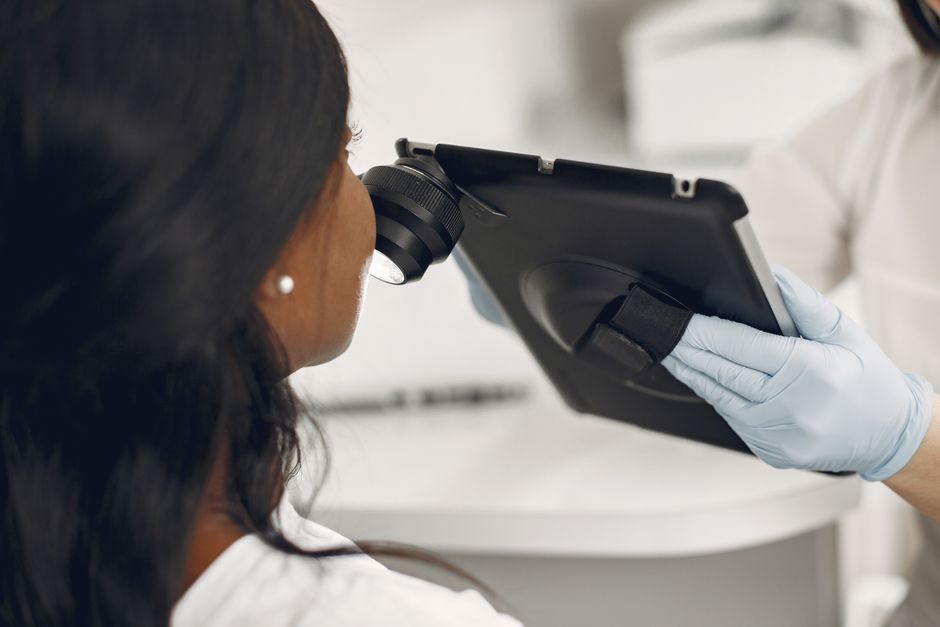
At your consultation the doctor examines the area closely under magnification and angled light. The cards below show the clues used to tell them apart.
Ice pick scar
- Clustered where acne was worst, often cheeks or temples
- Steep, deep walls; may look like a dark dot in side light
- Often uneven in size and spacing
- Does not change with oil, cleansing or season
- Treated with TCA CROSS or punch techniques
Enlarged pore
- Spread evenly over the nose and inner cheeks
- Shallow, round opening; may hold oil or a plug
- Similar sizes in a regular pattern
- Often looks larger with oiliness, heat or age
- Treated with skin care, resurfacing or pore laser
 Hommage · Gangnam
Hommage Women's Clinic · Gangnam, Seoul
Magnification and angled light separate ice pick scars from pores. Illustrative photo.
Comparing options
TCA CROSS vs punch excision for ice pick scars
Both treat ice pick scars one at a time, but in different ways. TCA CROSS builds the scar up from the inside over several sessions and needs no stitches. Punch excision removes the scar in a single procedure and swaps a deep pit for a fine line. The classic acne scar algorithm by Jacob, Dover and Kaminer recommends punch excision for ice pick scars with deep bases; since then, TCA CROSS has become the most common first-line office method because it is quick, repeatable and leaves no line.
| Compare | TCA CROSS | Punch excision |
|---|---|---|
| Best suited to | Most ice pick scars, especially many small ones | Wider or very deep ice pick scars with a defined base |
| Sessions | Typically 2–4, about 4–8 weeks apart | Usually once per scar, then resurfacing |
| Recovery | Small dark crusts for about 5–7 days | A fine stitch or tape for about a week |
| Main specific risk | Temporary dark marks; rarely a widened scar | A fine line scar or slight height difference |
 Hommage · Gangnam
Hommage Women's Clinic · Gangnam, Seoul
Targeted treatment is precise work, done scar by scar by the physician. Illustrative photo.
Treatment day
What happens during ice pick scar treatment
A TCA CROSS session is short. The skin is cleansed and degreased, and each ice pick scar is marked under good light. Using a very fine applicator, the doctor presses a small amount of high-strength trichloroacetic acid into the base of each scar until it turns white, a sign called frosting that appears within seconds. Only the scar is treated, not the skin around it. Most people feel a brief sting at each spot rather than lasting pain, and numbing is usually not needed.
If punch excision is chosen for a particular scar, the area is numbed with a local anesthetic injection. A tiny round blade, sized to the scar, removes it, and the opening is closed with a fine stitch or surgical tape. Resurfacing is planned for a few weeks later, once everything has healed.
After the session
Treated scars look slightly raised and pink at first, then darken into small crusts over a few days. These fall off on their own in about 5–7 days. The scar floor continues to rise over the next 2–3 months, which is why sessions are spaced weeks apart.
Schedule
Ice pick scar treatment schedule: sessions and timing
An ice pick scar plan usually runs over four to six months. Each TCA CROSS session needs time for the collagen response to build before the next, so spacing matters. Reviews of TCA CROSS suggest longer gaps, around 6–9 weeks, for higher acid strengths or for skin that tends to darken, which applies to many Asian skin types.
Aftercare
Ice pick scar aftercare: do's and don'ts
The week after TCA CROSS is mostly about leaving the small crusts alone and protecting the skin from sun. Picking a crust off early is the most common reason for a dark mark or an uneven result. You receive written instructions before you leave the clinic.
Do
- Wash gently with lukewarm water and a mild cleanser
- Apply the recommended ointment or moisturizer
- Let crusts fall off naturally in about 5–7 days
- Use broad-spectrum SPF 30+ every day
- Keep punch-site tape or stitches dry as instructed
- Message the clinic if a spot stays open after two weeks
Don't
- Pick, scratch or scrub off crusts
- Use retinoids, acids or peels until cleared
- Sunbathe or spend long hours outdoors unprotected
- Use saunas or swim in the first days
- Cover crusts with heavy makeup
- Book other facial treatments without asking
 Hommage · Gangnam
Hommage Women's Clinic · Gangnam, Seoul
Gentle cleansing and patience with crusts protect the result. Illustrative photo.
Evidence
Does TCA CROSS work for ice pick scars? What the research says
TCA CROSS has been studied more than most acne scar treatments, and a 2026 review of 34 publications concluded it works best for ice pick scars, followed by boxcar scars, then rolling scars. Even so, the studies are mostly small, use different acid strengths and grading scales, and few include many patients with darker skin types. The findings below are encouraging but should be read as averages, not predictions.
Good or excellent
60 patients, 4 sessions of 100% TCA CROSS for ice pick scars; 41.7% excellent, 45% good, none poor.
Amin et al., J Pak Assoc Dermatol, 2019With 70% TCA
Of 53 patients with atrophic acne scars had good or excellent improvement; 81% satisfied.
Dermatol Surg, 2015;41(5)Dark marks
Range of temporary hyperpigmentation across TCA CROSS studies, usually transient.
Stratman & He, J Clin Aesthet Dermatol, 2026Most common type
Estimated share of atrophic acne scars that are ice pick scars.
Fabbrocini et al., Dermatol Res Pract, 2010Traveling to Seoul
Ice pick scar treatment in Seoul for international patients
TCA CROSS suits short trips better than many scar treatments, because each session is quick and the crusts settle within about a week. Many visitors have the scar map and a first TCA CROSS session on one trip, then plan a second trip 4–8 weeks later, or combine the visit with resurfacing on a later stay.
Planning your visit
- Send close-up daylight photos of the scarred areas by WhatsApp, KakaoTalk or the contact form before booking.
- Allow about 7 days in Seoul after a TCA CROSS session so crusts can fall off before you fly; allow a week for stitch care after punch excision.
- Bring your passport, a list of medicines (especially isotretinoin or retinoids) and records of earlier scar treatments.
- Pack sunscreen and a hat; long flights and sightseeing mean more sun than you expect.
 Hommage · Seoul
Hommage Women's Clinic · Gangnam, Seoul
Seoul: the clinic is in Gangnam, a short walk from Sinnonhyeon Station. Illustrative photo.
 Hommage · Gangnam
Hommage Women's Clinic · Gangnam, Seoul
You receive a written plan and quote before starting. Illustrative photo.
Choosing well
How to choose a clinic for ice pick scar treatment
Because ice pick scars are treated one by one, the skill of the person applying the treatment matters more than the device. Ask these questions at any consultation, including ours:
- Does a physician apply the TCA CROSS? High-strength acid placed scar by scar needs a trained hand.
- Are scars separated from pores? Treating pores as scars wastes sessions and adds risk.
- Is the applicator precise? Fine applicators limit acid spread beyond the scar.
- Is the acid strength matched to my skin? Ask how pigment risk is managed for Asian skin.
- Is punch excision available when needed? Some deep scars respond better to removal.
- Do I get a written plan and quote? Including session count and spacing.
What affects the cost of ice pick scar treatment?
Cost depends mainly on how many scars are treated, how manyTCA CROSSsessions are needed, whether any scars are better suited to punch excision, and whetherRF microneedlingorfractional laseris added. Cosmetic scar treatment is not covered by Korea's National Health Insurance, and you receive a written quote before starting.
Your visit
What to expect at your ice pick scar consultation
01
Scar identification
The physician examines each area under angled light and separates ice pick scars from pores and other scar types.
02
Health check
Active acne, recent isotretinoin use, cold-sore history and pigment tendency are reviewed before timing is set.
03
Targeted plan
You receive a written plan and quote: TCA CROSS or punch techniques for each scar, then resurfacing.
04
Treatment and review
Sessions are usually 4–8 weeks apart, with treated scars compared and retreated where needed.

Your doctor
Dr. Hwang Seonhwa
Physician · Skin & Aesthetic Treatments
Dr. Hwang treats ice pick scars one at a time, using TCA CROSS for most and considering punch techniques for wider or very deep scars. Resurfacing is added afterward to blend the surrounding skin, and each scar's response is reviewed before the next session.
Physician for face and skin procedures, including lifting, laser and skin-improvement treatments, planned around facial proportions and skin condition.
Ice pick scars: frequently asked questions
What treatment works for ice pick scars?
Ice pick scars usually respond to treatments that reach the base of each scar. TCA CROSS is the most common first choice, and punch excision or grafting can suit wider or very deep scars. RF microneedling or fractional laser is then added to smooth the surrounding skin. Surface treatments alone rarely lift ice pick scars much.
Can ice pick scars be removed completely?
Ice pick scars can usually be made noticeably shallower and less visible, but no treatment reliably removes them completely. Punch excision removes the scar itself but leaves a fine line scar in its place. How much change you see depends on how deep the scars are, how many there are and how your skin heals.
Why doesn't laser work well on ice pick scars?
Ice pick scars are very narrow and can extend deep into the dermis or below, so laser columns spread across the skin rarely reach their base. Laser still helps smooth the surrounding texture once the scars themselves have been treated with TCA CROSS or punch techniques, which is why the two are often combined.
How many TCA CROSS sessions do ice pick scars need?
Most people need 2–4 TCA CROSS sessions spaced about 4–8 weeks apart. Shallower ice pick scars may lift after fewer sessions, while deep ones often need more or a punch technique instead. Each scar's response is checked before the next session, and the full effect of each treatment develops over about 2–3 months.
Are ice pick scars the same as large pores?
No. Large pores are normal openings of hair follicles and oil glands, usually spread evenly across the nose and cheeks. Ice pick scars are areas of scar tissue left by deep acne, often clustered where breakouts were worst, and they usually have steeper, deeper walls. A close examination under angled light tells them apart.
Can foreigners get ice pick scar treatment in Seoul?
Yes. International patients and foreign residents can book scar treatment at Hommage Clinic; bring your passport for registration. TCA CROSS is usually repeated 4–8 weeks apart, so plan return visits or a longer stay, and allow about a week for the small crusts to fall away. Please contact us before your visit to arrange language support.
Does TCA CROSS hurt?
Most people feel a brief, sharp sting at each scar as the acid is applied, which fades within a minute or so. Because only the scars are treated, numbing is usually not needed. Punch excision, if chosen, is done under a local anesthetic injection.
What do ice pick scars look like after TCA CROSS?
Treated scars turn white during treatment, then look pink and slightly raised. Over the next few days they form small dark crusts that fall off on their own in about 5–7 days, leaving pink spots that fade over the following weeks. The scar floor keeps rising gradually for about 2–3 months.
Can TCA CROSS make ice pick scars worse?
It is uncommon, but a scar can occasionally widen or look deeper, especially if acid spreads beyond the scar. A 2026 review linked most such reports to crude applicators. Temporary dark marks are more common, particularly in Asian skin. Fine applicators, careful acid strength and good aftercare lower these risks.
Is microneedling good for ice pick scars?
On its own, microneedling gives limited change in ice pick scars because the needles rarely reach their base. One study combining subcision and microneedling found ice pick scars improved much less than rolling or boxcar scars. Microneedling is best used after targeted treatment to smooth the surrounding skin.
Can I wear makeup after TCA CROSS?
It is best to avoid makeup directly over the crusts until they fall off, usually about 5–7 days. You can usually apply sunscreen and light makeup around the treated spots. Once the crusts have gone, gentle mineral makeup can cover any remaining pinkness.
Will ice pick scars come back after treatment?
Improvement from TCA CROSS and punch excision is generally long-lasting, because it comes from new collagen or from removing the scar. New deep acne can create new scars, and aging can make remaining scars look a little more visible over many years, so acne control and sun protection help keep the result.
Can ice pick scars be treated together with boxcar and rolling scars?
Yes, and most people need that, because scar types are usually mixed. Ice pick scars are treated individually with TCA CROSS, rolling scars are released with subcision, and deep boxcar scars may need TCA CROSS or a punch technique, before resurfacing blends everything together.
References
Sources used for this page, reviewed by Dr. Hwang Seonhwa. Read our editorial and medical review policy.
- Jacob CI, Dover JS, Kaminer MS. Acne scarring: a classification system and review of treatment options. J Am Acad Dermatol. 2001;45(1):109–117.
- Fabbrocini G, Annunziata MC, D'Arco V, et al. Acne scars: pathogenesis, classification and treatment. Dermatol Res Pract. 2010;2010:893080.
- Stratman S, He H. The use of chemical reconstruction of skin scars (CROSS) method with trichloroacetic acid (TCA) for atrophic scars: a comprehensive review. J Clin Aesthet Dermatol. 2026;19(6):52–67.
- Amin S, Rashid T, Shehzad A, Arshad A, Younas S. Outcome of CROSS technique with 100% trichloroacetic acid in the management of atrophic icepick acne scars. J Pak Assoc Dermatol. 2018;28(4):485–488.
- Therapeutic response of 70% trichloroacetic acid CROSS in atrophic acne scars. Dermatol Surg. 2015;41(5):597–604. PubMed
This page is general information and does not replace a personal consultation. Illustrations are original works of Hommage Women's Clinic, Gangnam, Seoul; photos marked illustrative are not of patients.
Related acne scar treatments
TCA CROSS Treatment
The procedure in detail: how acid is applied to each scar, recovery and number of sessions.
Boxcar Scar Treatment
Wider, sharp-edged scars treated according to whether they are shallow or deep.
Rolling Scar Treatment
Wide, wave-like scars pulled down by fibrous bands, usually released with subcision.
RF Microneedling for Scars
Blends the skin around treated ice pick scars with lower pigment risk for darker skin.
Fractional Laser for Acne Scars
Laser resurfacing to smooth texture once deep scars have been treated individually.
Subcision for Acne Scars
Releases tethered rolling scars that often sit alongside ice pick scars.
Find out which of your scars are ice pick scars
Book an appointment with Dr. Hwang Seonhwa in Gangnam to have each scar identified and receive a written plan for TCA CROSS, punch techniques and resurfacing.
Hommage Clinic · 4F, Building A, 509 Gangnam-daero, Seoul (near Sinnonhyeon Station) · Mon & Fri 10:00–20:00 · Tue–Thu 10:00–19:00 · Sat 10:00–15:00